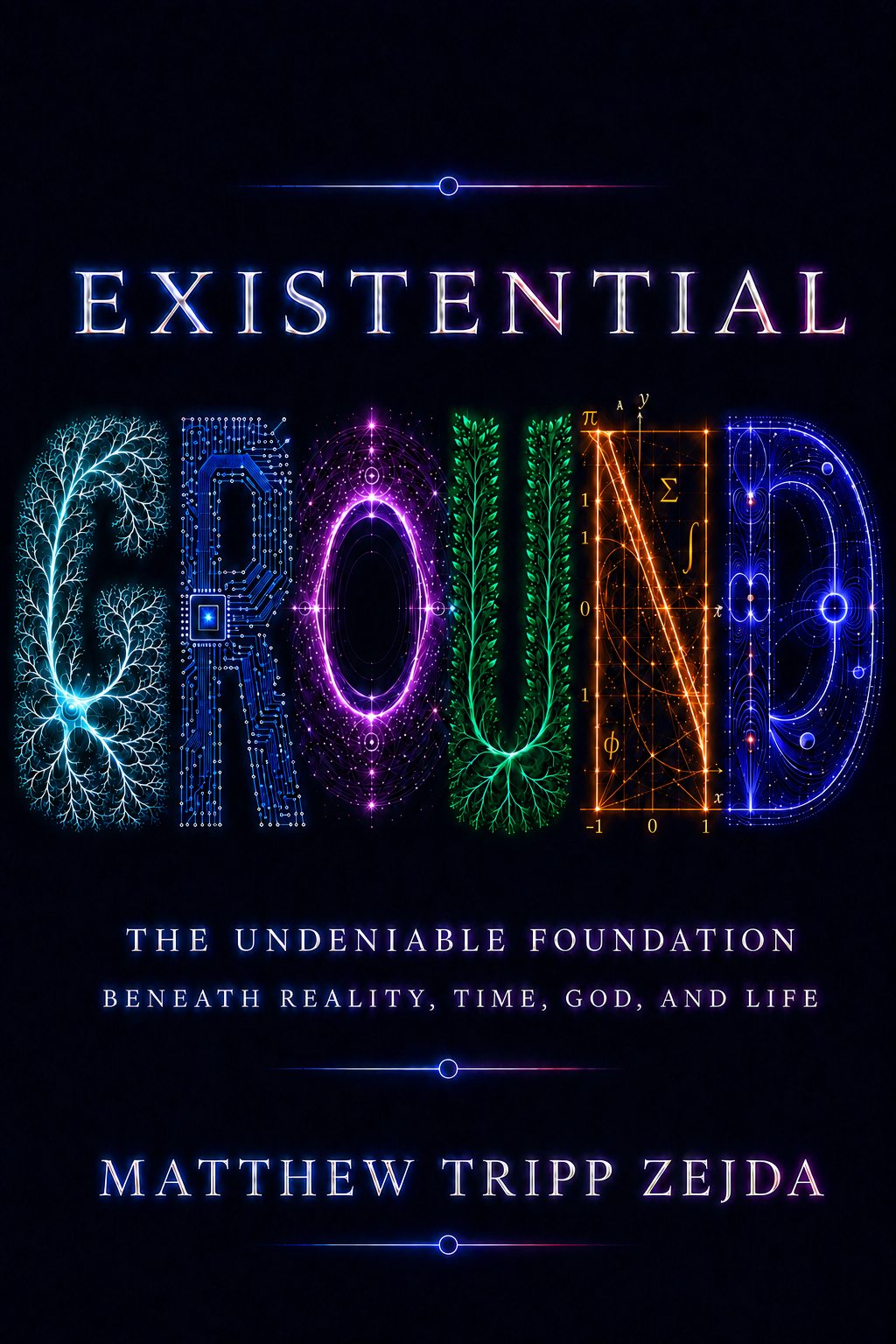

Existential Logicism / Foundations
Existential Logicism and Undeniable Facts
A denial cannot remove what its own performance requires.
I begin by separating beliefs that feel obvious from claims whose denial already depends on them. Conviction can be mistaken. An existential anchor has a different kind of support: the attempt to deny it supplies or requires the very condition its content rejects.
This is the starting method of Existential Logicism. I don’t ask you to choose a foundation because it is comforting, traditional, or mine. I ask you to examine the act of denial, identify what makes it possible, and see whether it can coherently remove those conditions.
What I mean by undeniable
A claim does not become undeniable because somebody refuses to question it. It does not become undeniable because a community agrees, an authority commands assent, or an alternative is difficult to imagine. Those are facts about belief and behavior. The issue here is what an actual denial must presuppose.
I distinguish the act from its content. Saying, thinking, or displaying a claim is something that occurs. What the claim says may nevertheless be false. Ordinarily, there is no conflict in that arrangement. The special case arises when the content denies a condition required by the very act expressing it.
I call that relation performative self-undermining. The denial can be uttered and understood, but it cannot be true of its own obtaining conditions. Calling the denial incoherent does not mean the words cannot appear. It means the claim defeats itself when those words are actually used to make that denial.
The question is not how firmly I believe a proposition. It is whether its denial can occur without already requiring that proposition to hold.
How the denial test works
- State the claim and its target. Identify exactly what is being denied. A claim about this act, a claim about some other situation, and a claim about all actuality do not have the same scope.
- Consider a meaningful denial. The words must function as an assertion, judgment, or other contentful act. Disagreement is not excluded merely because it challenges the claim. An impossible or meaningless denial cannot earn a proposition anchor status by default.
- Establish the required conditions. Show what must obtain for that denial to be performed. The connection must follow from the act’s conditions, not from an assumption inserted to guarantee the preferred answer.
- Compare those conditions with the denial’s content. If the act entails the very proposition it denies in the same context, the denial is self-undermining. Carry forward exactly that result, with its scope intact.
The final step matters as much as the first. A demonstration that the present act occurs does not, by itself, describe the contents of a different hypothetical situation. Nor does a result about one specified class of denials automatically establish every claim about every possible kind of reasoning.
The denial that supplies its own counterexample
Consider the claim that some occurrence obtains. Its global negation says that there are no occurrences at all. Yet actually formulating that negation is already an occurrence. The denial supplies a witness against its own content.
A dream does not escape this. Discovering that an apparent scene was a dream can change what I know about the scene, but it does not erase the dreaming. A mistaken thought remains an occurring thought. A simulation can change the account of what carries a representation without making the representation’s actual occurrence disappear.
This is the core application developed in the Epistemic Refutation Paradox. The minimum result does not first require a privileged “I,” a particular substance, or a rich theory of consciousness. Where experience is given, that experience occurs. The argument reaches the more basic fact that something obtains.
The distinction gives skepticism a definite place. I can question an interpretation, a memory, a source, or a theory. I cannot use an occurring doubt to make the occurrence of every doubt and everything else disappear.
Formal Argument
The Undeniability Schema
The following definition, theorem, and proof appear in Chapter 1, section 1.4 of the Logic-Based Engine.
Definition 1.1. Existential Logicism–Undeniability
A proposition φ is Existential Logicism–undeniable over a stated class of contexts when a meaningful denial of φ about its own context presupposes φ in that same context. The denial is an act; ¬φ is its content. Writing D(A, c, ¬φ) for an actually performed denial by A in context c, the condition is
Here φ[c] is the proposition evaluated at the context its denial concerns. The presupposition must be established from the conditions of that act, not assigned merely because I call the proposition undeniable. The intended denial must also be a meaningful act in the stated class, so an impossible or meaningless denial does not give a proposition this status vacuously.
An assertion about a hypothetical situation has that situation as its target. Its occurring here does not, by itself, settle what is true there. Likewise, inability to coherently deny a proposition in one class of acts is not automatically a proof that every unrelated act presupposes it.
Theorem 1.1. Existential Logicism–undeniability Schema
Let φ be Existential Logicism–undeniable in the sense of Definition 1.1. Then:
- Inescapability. A meaningful denial of φ about its own obtaining conditions cannot be true in the context of that denial.
- Foundational status. Within the stated class, a denial cannot coherently remove a condition its own performance requires. Extending this foundational status to every reasoning act requires establishing that those acts also presuppose φ.
- Asymmetry with ordinary beliefs. An ordinary contingent belief may be denied without its denial making the belief true. An undeniable proposition has the opposite structure within its stated scope: the denial supplies or requires what its content excludes.
Thus the schema identifies existential anchors through their demonstrated role, without treating every later structural conclusion as another instance of the same minimal result.
Proof
Fix a performed denial D(A, c, ¬φ). By Definition 1.1, its obtaining conditions entail φ[c]. Its content asserts ¬φ[c]. The act and the truth of its content therefore cannot obtain together, proving (1).
For (2), any proposed denial in the same class must again satisfy those conditions. It cannot remove their entailment merely by stating the opposite. If the same conditions are independently shown to be necessary for every reasoning act in a larger class, the conclusion extends to that class; the denial-conditioned premise alone does not supply that extension.
For (3), compare a belief whose content can be false while its denial occurs without contradiction. Such a belief lacks the defining entailment. The difference is the relation between an act and its required conditions, not the confidence with which either claim is asserted. □
In this notation, A is the agent, c the relevant context, φ the proposition, and ¬φ its negation. D names the performed denial, not a causal or grounding-dependence relation.
What this establishes, and how the inquiry continues
An existential anchor is not a premise I select because I need somewhere to stop. Its foundational role is established by showing what an attempted denial itself requires. That separates a discovered constraint from an arbitrary stopping point without pretending that every later question of explanation has already been answered.
The seven pillars form a connected account, but they are not seven copies of one proof. As Remark 1.2 explains, ERP secures minimum occurrence. The Illusion of Nothingness separately examines whether absolute nonbeing can function as a realized state or an exhaustive account of actuality.
Logical Elimination of Infinite Regress, Persistent Present Determinism, the Spectrum of Consciousness, the Contingency Guillotine, and Deterministic Moral Forces introduce further structural, explanatory, or evaluative premises. Their conclusions must be followed through those arguments. Inheriting occurrence does not make every additional proposition an immediate consequence of occurrence alone.
This is not a retreat from those conclusions. A conclusion established under its premises retains that force. Keeping the dependencies visible prevents both false certainty and false modesty. An unresolved question about a law, a carrier, or a valuer cannot erase an occurrence independently secured by the very act of asking the question.
From indiscriminate doubt to actual inquiry
I can now ask which account explains what occurs, what evidence supports it, and what would show that a particular inference is mistaken. Changing the description of an occurrence is different from eliminating every occurrence. Calling a proposal imaginable is also not enough to establish its coherence or explanatory support.
Tripp’s Prison takes up the finite standpoint from which inquiry proceeds. Fair comparison does not require a perspective outside every possible interface. It requires identifying what the evidence warrants, applying relevant standards consistently, and allowing correction. Shared knowledge needs that further argument, not merely an appeal to agreement.
Questions about the argument
Is “meaningful denial” just a way of ruling out disagreement?
No. A denial can be meaningful and still be false or self-undermining. I do not get to call it meaningless simply because I disagree with it. The claim must have enough content for its target and implications to be identified, and I must then show what its performance requires. Random sounds do not establish a refutation, but excluding random sounds does not prove an anchor either.
The definition expressly requires a meaningful denial in the stated class. It does not award undeniability to a proposition merely because its supposed denial cannot be formulated.
Does being unable to deny something make it true?
Psychological inability does not. People can be frightened, mistaken, or unwilling to question a belief. The formal test concerns an entailment: the conditions of the denial establish the proposition in the context under discussion. If that connection has not been demonstrated, calling the proposition undeniable adds nothing.
In the occurrence example, the denial is not merely accompanied by confidence that something exists. Its actual performance is the occurrence that defeats the global claim that none obtains.
Isn’t this just the law of noncontradiction?
The proof uses the incompatibility of the asserted negation with the condition established by its performance. I am not claiming to derive an entire logic without using inference. The distinctive question is which particular propositions are established by the conditions of their own denial. That requires examining the act and its content, not merely reciting a general rule about contradictions.
Could another kind of mind, language, or logic evade the result?
A different label alone changes nothing. The proposed account must make clear what counts as the act, what its content denies, and why the claimed entailment fails. Where the stated conditions no longer apply, their application must be argued rather than assumed. Where they do apply, changing vocabulary does not remove the condition established by the act.
The ERP occurrence argument does not first require a human subject or a particular theory of consciousness. Its question is whether an actual global denial can remove its own occurrence.
Does a narrow foundation leave us knowing almost nothing?
A starting point and a complete explanation have different jobs. The anchor secures what its argument establishes. Further reasoning, comparison, and evidence can establish more without requiring every conclusion to have the same kind of support.
I do not have to choose between certainty about everything and ignorance about everything. I have to show the connections. The purpose of the remaining pillars is to continue that work.
Terms used here
- Existential Logicism–undeniability
- The relation defined in Definition 1.1: a meaningful denial about its own context requires the proposition it denies in that same context.
- Existential anchor
- A proposition whose foundational role is demonstrated through the required conditions of its denial. The role and its scope must be established, not assigned by confidence.
- Performative self-undermining
- A conflict between an act’s required conditions and what its content denies. The act can occur even though its denial cannot be true of those conditions.
- Occurrence
- A minimally individuable obtaining item, state, fact, event, process, or state-change. An occurrence need not be correctly interpreted or consciously experienced. A dynamic event is one kind of occurrence, not the definition of all obtaining.
- Epistemic act
- An occurrence in which a contentful representation is formed, entertained, doubted, denied, or asserted at an epistemic interface.
- Inescapability and foundational status
- The denial cannot coherently remove a condition its own performance requires. A broader claim about other acts needs the corresponding dependency to be shown.
- Asymmetry with ordinary beliefs
- An ordinary contingent belief can be false while its denial occurs. In an undeniable case, the denial’s obtaining conditions establish the proposition that its content rejects.
Sources and related reading
- Matthew Tripp Zejda, Existential Logicism: A Logic-Based Engine for Navigating Reality, Chapter 1, §1.4: Definition 1.1, Theorem 1.1, and Remark 1.2.
- The same work, Chapter 2, §2.5: occurrence, epistemic acts, the Epistemic Refutation Paradox, and the distinction between occurrence and its interpretation. Section 2.11 develops Tripp’s Prison and shared structural warrant.
- For the continuous prose, A Logic-Based Tool for Navigating Reality, Chapters 1 and 2.