
Existential Logicism / Pillar 1
Epistemic Refutation Paradox
A denial of every occurrence is already an occurrence.
I can question what an experience means, whether a memory is accurate, or whether an apparent world is being simulated. What I cannot coherently do is erase every occurrence while performing the act of questioning. The doubt itself supplies something that its global denial would have to remove.
I call this the Epistemic Refutation Paradox, or ERP. It is the first pillar of Existential Logicism: a starting point that survives the attempt to deny it, without first requiring a privileged self, reliable senses, or an agreed account of what reality is made of.
Doubt leaves something in place
Suppose everything I take to be familiar is mistaken. The scene could be a dream. The memory could be false. What I call perception could be the output of a process I do not understand. Granting those descriptions changes how I classify what is happening. It does not make the dreaming, remembering, or representing disappear.
The distinction is between an occurrence and the content or interpretation associated with it. A sentence can exist while saying something false. A thought can occur while misidentifying its object. A hallucinated elephant need not be a real elephant for the hallucination to be real as an occurrence.
By occurrence, I mean any minimally individuable obtaining item, state, fact, event, process, or state-change. The term is not restricted to what a human notices or correctly understands. A dynamic event is one kind of occurrence; it is not the definition of everything that obtains.
I may be wrong about what an occurrence is. That does not make me right that no occurrence obtains while I am making the mistake.
ERP addresses the global claim that no occurrences obtain at all. That claim includes the very formulation through which it is raised. If I exempt the formulation, I have already kept an occurrence. If I include it, the actual formulation contradicts what the claim says.
The words “nothing occurs” can be written or spoken. The paradox does not make their appearance impossible. It shows why their global content cannot be true in the very context where they are actually formulated.
The argument in three steps
- An actual doubt, denial, or assertion is an occurrence. This holds whether it is spoken, silently entertained, or carried by a contentful computational token.
- The global claim “no occurrences obtain” denies that very occurrence. Its scope cannot exclude its own performance while remaining global.
- The claim therefore cannot be true where it is being raised. The act provides the occurrence that defeats the global negation. In that context, some reality obtains.
The proof does not begin by trusting the skeptical claim, trusting the senses, or deciding what kind of mind produced the sentence. It uses the occurrence of the attempted denial itself.
An unused capacity is not an actual token. A real system capable of formulating a sentence already obtains as a system, but I do not infer that it has performed every sentence it could formulate. The proof below keeps actual performance and mere capacity distinct.
The formal argument
The definitions and results below come from A Logic-Based Engine for Navigating Reality, section 2.5. G names the global negation; E identifies an epistemic interface; R states that some reality obtains.
The central result is Theorem 2.4. Its definitions and supporting lemmas are included so the conclusion can be examined together with the conditions it uses.
Definitions 2.1–2.6: occurrence, reality, and tokening
Definition 2.1. Occurrence
An occurrence is any minimally individuable obtaining item, state, fact, event, process, or state-change. A dynamic event is one kind of occurrence, not the definition of all obtaining. This includes, but is not limited to:
- physical events (e.g. a rock falling, a neuron firing),
- computational steps (e.g. a calculator executing an instruction),
- tokenings of symbols or thoughts (e.g. a sentence being formulated or displayed),
- illusory, hallucinated, or misclassified happenings (e.g. “seeing” a pink elephant in a dream).
We place no requirement that an occurrence be consciously experienced or accurately interpreted by any agent. occurrence is strictly ontological, not phenomenological.
Definition 2.2. Reality
Reality is the totality of all occurrences. To say that “reality obtains” is just to say that at least one occurrence obtains.
Definition 2.3. Epistemic interface
An epistemic interface is the way in which an agent (human, animal, AI, etc.) is related to occurrences: the structured pattern by which occurrences impact, update, or are registered in the agent’s internal states. What a human calls “experience” is one kind of epistemic interface. Epistemic Refutation Paradox does not presuppose any particular structure for this interface; it only relies on the fact that some interface must exist for there to be any doubting, denying, or reasoning at all.
Definition 2.4. Epistemic agent
An epistemic agent A, in the minimal sense used here, is an actually instantiated system capable of tokening substantive representational states. Write CanTokA(S) for that capacity and TokA(S) for an actual tokening of S by A. Then
while the converse is not assumed. A tokenable state need not have been performed. This minimal agent need not be self-aware or capable of reflecting on its own mental status. The richer predicate EA introduced in Definition 6.7 identifies a subtype, not a replacement for this definition.
Definition 2.5. Global negation of occurrence
Let G denote the following proposition:
“There are no occurrences at all; nothing ever happens; no reality obtains.”
Any position that asserts, endorses, or attempts to defend G will be called a global negation of occurrence.
Definition 2.6. Epistemic act
An epistemic act is any occurrence in which a contentful representation is formed, entertained, doubted, denied, or asserted at an epistemic interface. Examples include:
- silently wondering “does anything exist?”,
- asserting “nothing is real”,
- computing or displaying the string “no occurrences obtain”.
By definition, every epistemic act is an occurrence (Def. 2.1).
Lemmas 2.1–2.3: the premises in operation
Lemma 2.1. Minimal Occurrence Principle
If any epistemic act occurs, then at least one occurrence obtains. Formally, for any epistemic interface E,
Proof
By Def. 2.6, an epistemic act is an occurrence. Thus the existence of an epistemic act entails the existence of at least one occurrence. The implication is immediate.
□
Lemma 2.2. Illusory Occurrences Are Occurrences
Let O be an occurrence that is misclassified, illusory, or otherwise epistemically defective relative to some interface E (for example, a dream, hallucination, simulation, or mistaken inference). Then O is still an occurrence in the sense of Def. 2.1.
Proof
Def. 2.1 places no constraints on correctness, veridicality, or awareness. It only requires that O obtain as an item, state, event, or process. The misclassification does not remove that occurrence. Therefore, even “fake” or misinterpreted happenings are still occurrences.
□
Lemma 2.3. Self-Application of Skepticism
Any coherent global skepticism must allow its own formulations (questions, doubts, denials) to fall under the scope of its claims.
Proof
Suppose a skeptic asserts G (Def. 2.5) but stipulates that G does not apply to the act of asserting G. Then the skeptic has introduced an ad hoc exception: the performative act of skepticism is treated as somehow outside the domain of what is being denied. This is a paradigmatic case of special pleading and breaks coherence. Therefore, any globally negating claim that aspires to coherence must also apply to its own performative instantiation.
□
Theorem 2.4. Epistemic Refutation Paradox
Let an epistemic interface E be such that at E the proposition G (“no occurrences obtain”) is entertained, asserted, or denied. Then G is necessarily false at E. Consequently, for any epistemic interface capable of formulating G, it is inescapably true that reality obtains.
Proof
Assume for contradiction that G is true at E, i.e. that no occurrences obtain.
However, by hypothesis, at E there is an epistemic act: G is being entertained, asserted, or denied. By Lemma 2.1, the existence of that epistemic act entails that at least one occurrence obtains.
Thus, under the assumption that G is true, we derive that an occurrence both does and does not obtain. This is a contradiction.
By Lemma 2.3, a global denial of occurrence cannot escape this entailment by exempting itself. Therefore G cannot be true in any context where it is formulated.
Hence, wherever the formulation is actually performed, its occurrence witnesses reality. An actually existing interface capable of hosting it is also an obtaining structure, even while that particular capacity is unused. The argument does not assert an unperformed token merely from its possibility. By Def. 2.2, reality obtains in the host context.
□
Corollaries 2.7–2.8: reality and illusion
Corollary 2.7. Inescapability of Reality
For any agent or system with an epistemic interface E that can raise global skeptical doubts (including G), it is logically impossible for that agent to be in a situation where “nothing is real” or “nothing ever happens.” The very act of doubting or denying guarantees that some reality obtains.
Corollary 2.8. Illusion Does Not Undermine ERP
Suppose an agent A later discovers that its prior experiences were illusory, misinterpreted, or simulated. This does not threaten Epistemic Refutation Paradox: those illusions, misinterpretations, or simulations were themselves occurrences and thus confirm, rather than undermine, the existence of reality.
Why the result does not begin with an “I”
In comparing ERP with the Cartesian cogito, I am identifying the smaller commitment needed for this result. ERP establishes occurrence without first establishing a thinking subject or deciding whether a particular system has a private experience. That is the sense in which I treat it as more general. I am not using a minimal token as a shortcut to a complete theory of mind.
Lemma 2.5. ERP Does Not Presuppose a Subject
Theorem 2.4 does not require:
- a distinguished first–person subject (an “I”),
- reflexive self–awareness,
- a conscious mental state in the phenomenological sense.
It only requires that there be an epistemic interface E at which some epistemic act occurs.
Proof
The proof of Theorem 2.4 refers only to occurrences and to epistemic acts as a subclass of occurrences (Def. 2.6). No premise involves an explicit subject, qualitative feel, or meta–awareness. A calculator executing a program that prints “nothing exists” satisfies the structural conditions: there is an epistemic act (the production of that string), which is an occurrence, and thus falsifies G. Hence the result is independent of any substantive theory of consciousness.
□
Epistemic grounding: Definition 2.11, Theorem 2.6, and Corollary 2.12
Definition 2.11. Irrefutability as Epistemic Ground
A proposition P is an epistemic ground if every attempt to deny P is self–refuting in the manner of Theorem 2.4. Such propositions cannot be coherently denied from within any epistemic interface; they form the non–negotiable backbone of any rational worldview.
Theorem 2.6. Reality as Epistemic Ground
The proposition
is an epistemic ground in the sense of Def. 2.11. Any attempt to deny R from within an epistemic interface is self–refuting.
Corollary 2.12. ERP as the First Pillar of Existential Logicism
Any philosophical or scientific framework that attempts to model reality from the perspective of an epistemic agent must presuppose R as an epistemic ground, on pain of self–refutation. Existential Logicism explicitly acknowledges this and builds all subsequent pillars (Illusion of Nothingness, Logical Elimination of Infinite Regress, Persistent Present, Spectrum of Consciousness, Contingency Guillotine, Deterministic Moral Forces) on top of the lattice of occurrence secured by Epistemic Refutation Paradox.
The connection to later pillars is a dependence on occurrence as a starting point. Their additional definitions, premises, and proofs still do their own work.
Using ERP without stopping inquiry
When a discussion becomes “perhaps nothing is real,” I first ask what is actually being denied. “My explanation may be mistaken” and “no occurrence obtains” are different claims. The first can invite better inquiry. The second includes an occurring denial among the things it says do not obtain.
I can grant a dream, deception, or simulation for the purpose of the argument. Then I can ask what that account explains, what evidence distinguishes it, and how its proposed process works. ERP does not select the best account for me. It prevents a possible misclassification from being used to erase every occurrence, including the inquiry itself.
The practical gain is a place to continue from. A question about meaning, responsibility, or the source of experience still needs its own answer. It is not answered by calling everything an illusion, and ERP does not manufacture those answers merely by establishing occurrence. It keeps them available for examination.
What the result establishes
ERP secures minimal realism: some occurrence obtains in the context of an actually performed doubt, assertion, or denial. That conclusion does not wait for confidence about the occurrence’s ultimate source. Discovering that a particular experience was deceptive changes its interpretation, not the fact that the deception occurred.
I am not claiming that ERP by itself proves the accuracy of perception, another system’s private phenomenology, a complete external-world model, physical determinism, or a particular moral judgment. Those are different claims. The conclusion here is neither “we can know everything” nor “nothing can be known.” It is the specific fact that global occurrence-denial defeats itself in performance.
A sentence made here about another hypothetical situation occurs here. That token cannot simply be moved into the situation it represents. ERP’s context is the one in which the formulation actually obtains. The broader work on nothingness addresses its own target through its own argument.
Undeniable Facts explains the general denial test. ERP supplies its first central application. Tripp’s Prison then asks how finite access can support knowledge of shared structure. Illusion of Nothingness examines absolute nonbeing, while Logical Elimination of Infinite Regress addresses explanatory dependence. These arguments inherit the starting point without becoming the same theorem.
Questions that clarify the argument
Is this just “I think, therefore I am”?
The connection is the self-defeating structure of a certain denial. My starting point is more minimal than a conclusion about a thinking self. A contentful symbol token can establish occurrence without deciding whether its host thinks or feels. Lemma 2.5 makes that distinction explicit. Consciousness and selfhood remain questions to investigate, not requirements silently inserted into the first premise.
Does this define reality as whatever I experience?
No. Occurrence is not defined by being experienced or correctly interpreted. A physical event, an obtaining state, or a computational step can qualify without awareness. Calling the totality of occurrences “reality” supplies a name for the conclusion. The work is done by identifying the actual token that the global denial would have to exclude.
What if logic or my reasoning is unreliable?
A particular inference can be mistaken, and ERP does not certify every rule or conclusion somebody calls logical. Its target is a meaningful global denial that applies to its own performance. Questioning a rule remains an occurrence. Abandoning the conditions under which the denial has a determinate content does not produce a successful denial of that occurrence; it removes the basis for treating the marks as that argument.
What if everything is an illusion or a simulation?
Then the relevant illusion or simulated representation still obtains. The claim concerns what it is and what carries it, not the absence of any occurrence. I can examine the proposed source and its consequences without conceding that a simulated scene is absolute nonbeing. The existence of the representation does not, by itself, establish that its depicted objects exist as presented.
What about the claim that no knowledge is possible?
Pointing out that a universal claim of ignorance cannot certify itself is not enough to explain what can be known. ERP supplies the specific occurrence witness: an actually raised denial cannot be true when its content denies every occurrence, including its own token. This is not a general guarantee for perception, memory, or induction. It is a determinate starting point rather than a conclusion that all remaining beliefs are equally unsupported.
Does ERP refute solipsism or prove other minds?
A solipsist who grants an occurring mind has already granted something real in ERP’s minimum sense. Whether that account adequately explains other-appearing agents and shared structure is a further issue. I do not turn my own token into direct access to another system’s private experience. Tripp’s Prison examines the conditions of comparison and shared warrant.
What if the self is only a constructed narrative?
That proposal concerns the organization of an identity. The actual construction or tokening of a narrative remains an occurrence. ERP does not require an independent inner substance before it can reject the leap from “the self is constructed” to “nothing obtains.”
What if the denial is silent, or nobody makes it?
A silently entertained doubt is still an epistemic act. If no denial is performed, ERP does not invent one from a system’s unused capacity. An actually existing system remains an obtaining structure; a merely represented candidate system is not thereby shown to exist. The theorem’s proof explicitly keeps those cases apart.
Read the source argument
- Matthew Tripp Zejda, Existential Logicism: A Logic-Based Engine for Navigating Reality, chapter 2, section 2.5, “Epistemic Refutation Paradox.” The formal statements above retain the source result numbers. Section 2.3 provides the historical discussion; section 2.11 develops Tripp’s Prison.
- Matthew Tripp Zejda, Existential Logicism: A Logic-Based Tool for Navigating Reality, chapter 2, for the continuous reading account of skepticism, occurrence, and finite knowing.
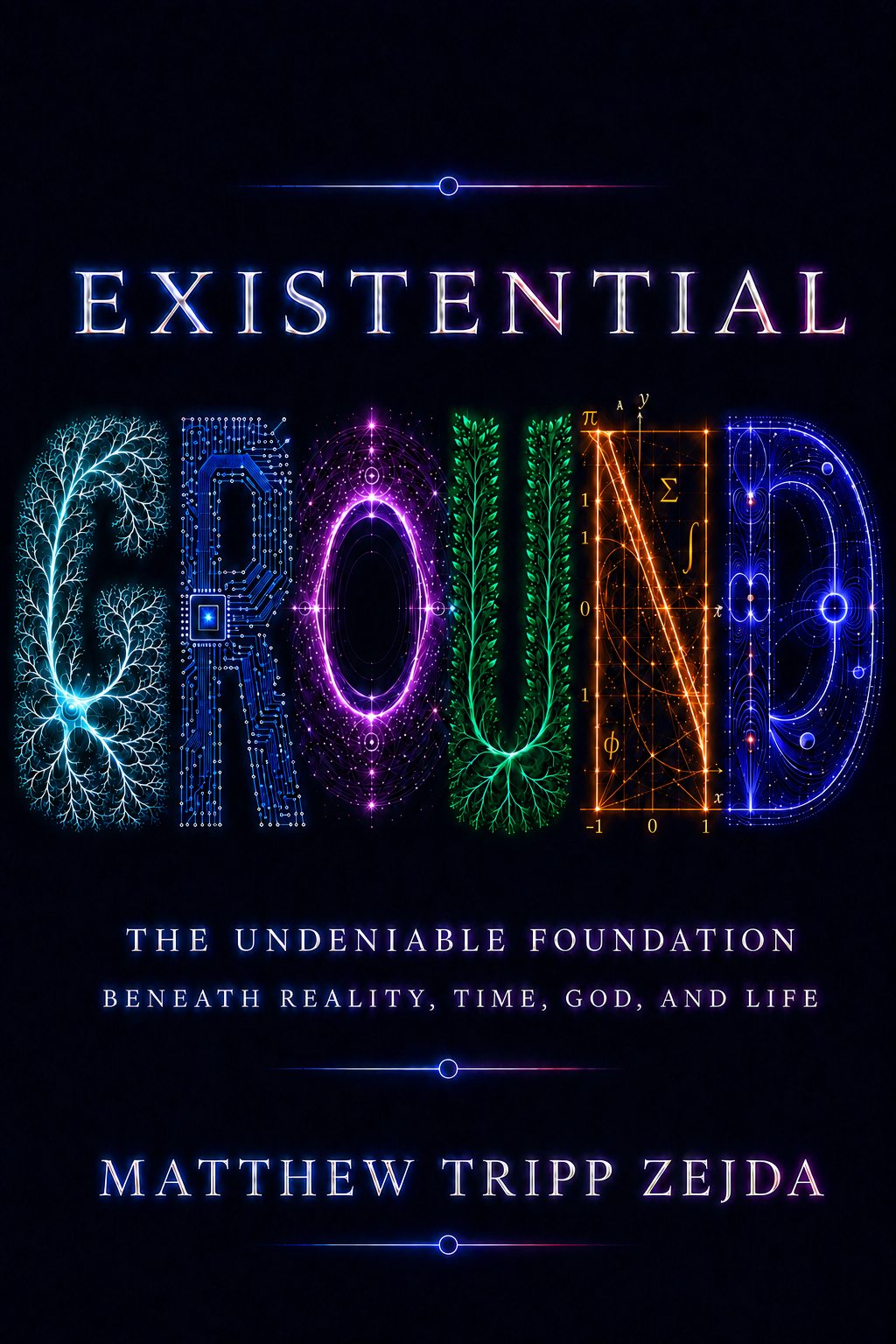
- Matthew Tripp Zejda, Existential Ground, chapter 3, “The One Place Reality Cannot Be Denied,” especially “Doubt leaves evidence behind,” for the occurrence argument’s place in the connected account.
Related ideas and reference material
Citation: Zejda, Matthew Tripp. Epistemic Refutation Paradox (ERP). Existential Logicism.