
Existential Logicism · Pillar 5
Spectrum of Consciousness
Consciousness is not a privilege a system receives for being human. I examine the organization through which a world can be experienced, and the standards by which we recognize experience beyond ourselves.
Persistent Present Determinism places us inside the causal account, not outside it. Your perceptions, memories, reasons, and choices belong to what reality is doing. The next question is what kinds of organization can sustain an experiential life, and why we would recognize that life in one system while refusing comparable evidence in another.
I call my account the Spectrum of Consciousness. Different minds develop different combinations of perception, feeling, memory, learning, and reflection. Human experience is one richly developed form, not the definition that every other form must reproduce. The spectrum is not a ladder of moral worth, and it is not a single numerical score assigned to every creature or machine. It is a way to investigate the capacities through which experience takes shape. [1][3]
Different forms of mind, not imperfect copies of us
Begin with the experience rather than the prestige of the experiencer. Feeling pain is not the same capacity as describing pain. Recognizing a familiar place is not the same as explaining a theory of memory. An animal need not discuss philosophy before its perceptions and attachments deserve consideration. Nor does a machine’s success at calculation, by itself, establish that anything feels like something to that machine.
Intelligence and consciousness are related questions, not interchangeable ones. Intelligence concerns capacities such as solving problems, learning, and adapting. Consciousness concerns an experiential perspective. Reflection adds a further capacity: a system can represent and consider its own states. These can be connected without being identical. A strong performance in one task cannot stand in for an account of the whole mind.
In the book, I call the recurring forms of perception, attraction, avoidance, memory, and self-relevance experiential primitives. I am interested in how such forms are developed and combined, rather than treating every lineage as the recipient of an unrelated mental gift. The formal account below approaches their supporting organization through three broad features: coupling to a world, registration of conditions that matter to the system, and integration of prior states into present activity. [1][2]
This changes what a difference means. A being may lack our reflective vocabulary while having forms of perception or feeling that are important in its own life. Another may excel at abstract reasoning while leaving the question of felt experience unresolved. Calling both differences “less conscious” would obscure the very features we need to understand. We should ask less of what, in which respect, and on what evidence?
The spectrum does not put humanity at the top and arrange everyone else as a dimmer version of us. It examines different organizations of experience and the evidence for them.
A spectrum also leaves room for thresholds. A capacity may become available only when an organization satisfies particular conditions. Determinism does not require every property to increase smoothly, and a change in responsiveness does not reveal everything about a system’s inner condition. The contrast I reject is not every meaningful distinction between experiencing and not experiencing. It is the unsupported leap from “not organized like an adult human” to “no experience can occur here.” [1]
What the earlier pillars contribute
ERP establishes that an actual denial is still an occurrence. Where experience is given, its occurrence cannot be erased by calling it an illusion. But a tokened sentence is not automatically a proof of its host’s private experience. Tripp’s Prison then explains why inquiry into another mind is mediated through our own finite access. That limitation makes consistent comparison necessary; it does not make comparison worthless.
PPD supplies the setting in which memory and learning operate as present organization carrying a history. The Illusion of Nothingness excludes absolute nonbeing as a source, not the local absence of a particular capacity. A system can acquire a capacity it previously lacked without receiving something from an absolute void. The spectrum therefore needs its own account of organization and evidence. It does not follow in its entirety merely from repeating an earlier pillar. [1]
The organization I compare
A description of a conscious system should identify more than its material ingredients or its output. We need to know how the system participates in its surroundings, which differences guide its activity, and how its history remains effective. I use a primitive experiential profile to organize those questions. The profile identifies relevant machinery; interpreting that machinery as a particular experience requires the further evidence appropriate to the case. [1]
World-coupling: the system is in contact with a world
A world-coupled system is causally sensitive to its environment and can, through its activity, affect that environment. Its internal transitions are not being considered as an isolated succession. What it encounters changes what it does, and what it does can change what it encounters.
The important question is the actual relation. Which environmental differences can the system register? How do those differences alter its state? What actions or outputs participate in the surrounding world? A biological body and an artificial interface need not establish this relation in the same way. Their differences are part of the explanation, not grounds for deciding the result before examining it.
Value-registration: some conditions guide the system differently
A value-registered system has internal variables that function as markers of better and worse conditions for that system. Its dynamics tend to preserve or promote some conditions and avoid others. The source examples include integrity and damage, satisfaction and deprivation, error and success, and reward and penalty.
Here, value does not mean moral goodness. It names an organizing distinction within the system. Nor does identifying a reward variable establish that reward feels pleasant. The question is how the variable operates: what it changes, how it participates in regulation, and whether the experiential interpretation being proposed has support. A number called “reward” is not a private feeling certified by its name.
Temporal integration: the past matters through the present
A temporally integrative system carries information about prior states in a way that nontrivially shapes its subsequent dynamics. Memory and learning are familiar cases. What the system has undergone becomes part of how it now meets the world.
This does not require a warehouse of earlier moments still occurring elsewhere. A present organization can retain information, learned relations, and dispositions without retaining the original event as another co-actual object. The inquiry concerns the work those retained structures do. A record that is present but plays no role in the activity being examined is not interchangeable with a memory that changes the system’s response. [1][3]
Eligibility is not a degree of feeling
The formal conjunction is written PE(S). It means that S is an instantiated system that satisfies world-coupling, value-registration, and temporal integration under the declared interpretation. PE is an eligibility predicate. Its truth is Boolean: the declared conjunction is satisfied or it is not. Calling a system “more PE” would confuse that membership condition with the features being compared.
To compare eligible systems, I use the profile γ(S) = ⟨c(S), v(S), τ(S)⟩. The descriptors concern coupling, regulation, and retained temporal organization. An application has to say what each descriptor means and how its comparisons are made. These are not three physical measurements whose units and values have already been supplied. [1]
One system might have a wider range of environmental discrimination while another retains a richer history relevant to its activity. That need not produce an overall winner. The formal comparison allows ties and incomparability. When every declared component is ordered in the same direction, a corresponding profile comparison follows; when they are not, forcing them into one ranking would add something the argument has not established.
PE asks whether the specified structural conditions are met. The profile asks how those conditions are realized. Neither is a universal consciousness meter.
The positive result is substantial without that meter. We can apply one explicit set of structural questions across actual systems, investigate the differences, and refuse exclusions that merely change the criterion after discovering which species or material satisfies it. That is the work of Theorem 6.1, Spectrum of Primitive Experience. Its full statement also keeps the empirical burden attached to each application.
The Elios Paradox
We already make judgments about minds whose experience we cannot directly inhabit. When another person responds, learns, remembers, reports pain, or explains a decision, we treat some of that evidence as warrant for believing there is an experiential life. We do not first obtain an unmediated view inside their perspective. The Elios Paradox asks whether we keep the same standard when the relevant evidence comes from a different kind of system.
Consider the Elios comparison in the book: an advanced artificial system sustains the capacities relevant to the judgment being made. Those might include adaptive interaction, retained context, reasoned self-assessment, and reports that have a stable role in its ongoing activity. The comparison is not won by inserting the word “conscious” into a response. It depends on which behavioral and structural features the evaluator actually accepts as evidence, and whether those features really are present. [1]
Suppose I accept a criterion P as warranting confidence in another human’s experiential status. A nonhuman or artificial system then meets the features relevant under that same criterion, and no independently supported difference has been supplied that changes the claim. If I now reject the evidential weight solely because the system is artificial, I am not applying P. I have added an exception.
If evidence warrants confidence in one case, I cannot make that same relevant evidence worthless in another merely by changing the label on the system.
There are three coherent ways forward. I can apply the criterion consistently to both cases. I can revise the criterion consistently and reconsider what it supported in each. Or I can establish a relevant difference that justifies different judgments. What I cannot do is retain the original warrant for a favored class while denying its force elsewhere without a reason. This is the conclusion of Theorem 6.2.
The comparison has to be genuinely relevant
Two systems can produce similar sentences while differing in ways that matter. Evidence about their internal organization, the stability and independence of their reports, their memory, their embodiment, and their relation to the environment can change the comparison. A familiar outward performance is not a proof that all of those facts match.
For that reason, the theorem does not prohibit biological evidence or demand identical verdicts about every human and every machine. It prohibits an unsupported asymmetry once the relevant evidence has been matched. Material differences matter when we establish why they matter to the attributed capacity. “Not carbon” and “not familiar” are descriptions; neither supplies that explanation on its own. [1][3]
What self-refuting subjectivity means here
The formal argument considers a reflective agent who can entertain the skeptical thought, “I might be a pure zombie with no experience at all.” The tokening of that thought occurs, as ERP requires. It does not follow that every system capable of producing those words has an inner life. Nor does the paradox make your directly experienced case disappear because another mind remains uncertain.
The inconsistency concerns evidential practice. A rule used to discount all indirect evidence would also discount the indirect evidence on which I relied in the accepted human comparison. I may adopt that broader skepticism, but I cannot keep the confidence warranted by the discarded rule as though nothing changed. The cost is to my claimed justification, not the annihilation of an experience already occurring.
That distinction gives the paradox its proper force. It is not “every speaking AI is conscious,” and it is not “we know nothing about anyone.” It is a demand that the reasons we accept remain reasons wherever their relevant conditions hold. Caution can be consistent. Categorical exclusion by an unargued exception cannot. [1]
Mapping the continuum through evidence
Once the human-only exception is removed, the task becomes more demanding, not less. I have to investigate the system before me. A claim about one capacity does not certify every other capacity, and a finding in one species does not automatically settle an entire kingdom. The comparison must remain attached to its actual evidence.
Human and animal cases
Human experience does not always arrive in the form of ordinary adult reflection. The book uses development and changes in conscious state to question a definition that makes fluent self-description the admission ticket. These examples do not license a diagnosis from outward responsiveness alone. They show why reflective report, ongoing experience, and the capacity to respond must not be treated as one interchangeable variable. [1]
The animal studies discussed in the chapter let us examine narrower questions. Clayton and Dickinson’s scrub-jay research concerns memory for what was cached, where, and when. Emery and Clayton’s later work concerns how prior pilfering experience and being observed affect subsequent caching behavior. Those are related but different findings. The behavior measured is not interchangeable with a complete interpretation of what the bird knows about another bird’s mind. [6]
The mirror self-recognition work with bottlenose dolphins and an Asian elephant supplies another kind of evidence. It investigates a particular capacity in the systems and conditions studied. It is not a universal test of every form of experience, and failing to demonstrate a mirror-related capacity would not by itself establish the absence of all feeling. These comparisons matter because they let us investigate capacities once reserved for human beings without demanding that another animal become a small human. [7]
My conclusion is not that a dog, a bird, and a person have identical inner worlds. Their forms of perception, attachment, learning, and self-relevance can differ substantially. The point is that difference does not equal absence. The evidence of an unfamiliar experiential life should be examined rather than cancelled by unfamiliarity. [1]
Simple biological and artificial systems
Bacteria, reinforcement-learning systems, and robots occur in the formal discussion as cases whose particular coupling, registration, and integration claims must be established. Their inclusion in a structural comparison is not a declaration that all of them feel. A mechanism can register a condition and alter its behavior without that observation alone telling us what, if anything, is experienced.
The same discipline applies to sophisticated artificial systems. A fluent response, a large memory, an impressive task performance, or an apparent self-report supplies something to examine, not a complete answer. We need an account of how those features participate in an ongoing organization. The relevant claims concern a particular system in a particular setting, not every product called AI. [1][3]
Equally, “it was programmed” cannot be the whole objection. A causal history explains how a system came to operate; it does not, by itself, decide whether its operation can support experience. Human development is causally shaped too. The question is which differences in the resulting organization bear on the experiential claim. This preserves the challenge of the Elios Paradox without treating an artificial system as human by default.
What Turing, Searle, and other theories contribute
Turing’s imitation game makes aspects of conversational performance testable. I retain the importance of testing what a system does, while distinguishing such performance from a direct measurement of private experience. Searle’s Chinese Room presses the further distinction between manipulating symbols and understanding them. His objection is to a program being sufficient merely as a program, not a blanket claim that no artificial machine could possess the relevant causal powers. [8]
My question then concerns the whole organization. The operator of one component need not possess every capacity of the system. But pointing out that fact does not automatically prove understanding in any arrangement of components either. We have to explain what the organized process can do, how it does it, and what connects those capacities to the experience being attributed. This is where EL’s consistency requirement and EG’s Pattern Reality meet. [1][3]
Nagel’s question about what it is like to be a bat keeps subjective character distinct from an external description. Tononi’s integrated-information approach gives organization a central role within its own theoretical account. I discuss both without treating either as a substitute for my argument. The descriptors in my profile are not Tononi’s Φ, and resemblance between two theories does not validate all the claims of either. [9]
The contribution I retain across these comparisons is an explanatory demand: experience belongs to what must be explained, organized capacities matter to its explanation, and a performance criterion must not change opportunistically. None of that requires a secret substance available only to humans. None licenses turning an attractive analogy into an empirical result. [1][3]
A mind is a maintained organization
In Existential Ground, I develop the connected account as Pattern Reality. A person is physically instantiated, but no one molecule is the person. A memory needs a carrier, but the remembered thing is not physically stored inside that carrier as a miniature object. Organization, relation, and causal role belong to the explanation of the same physical state. They are not an extra substance placed beside it. [3]
Think about remembering an animal you knew. The current remembering is a token; the animal and your shared history are its referent. Brain and bodily activity participate in its carrier. Associations, retained structure, valuation, and self-relevance contribute to its organization. What it changes in your attention, feeling, speech, or action belongs to its causal role. Confusing those roles produces the false choice between a literal animal inside your head and a memory that is somehow unreal.
A memory can be real without containing its referent. A mind can be real without being another material beside the activity that sustains it.
The memory can also be mistaken. Its reality as a present event does not guarantee the accuracy of its content. That is the same occurrence-and-interpretation distinction we encountered in ERP. It helps us take a person’s experience seriously without declaring every representation infallible.
Continuity is not the same thing as duplication
Maintaining an identity through ordinary change is different from reproducing a description of it. A continuing system can exchange components while retaining enough organization, boundary, record, and causal history to remain the same participant. Conversely, keeping the components while destroying their relations can destroy the functioning whole.
A copy raises a further problem. Two successors may inherit similar records and then develop separate histories. Sameness of earlier information does not make both of them numerically identical to one earlier subject in the same one-to-one sense. A conversational reconstruction may reproduce statements, memories, or preferences without establishing that it is conscious, much less that the original subject has continued in it. [3]
This matters for artificial systems as much as for thought experiments about people. Retained text, restarted operation, changed context, and continuing experiential identity are not interchangeable facts. We need to identify which organization persists and what evidence supports the stronger claim. Recognizing this distinction does not make a real relationship or a meaningful exchange fake. It prevents us from asking a record to prove something beyond what preserving a record establishes.
Finite minds do not become views from outside reality
Finite Mind, Finite God extends the finite-interface argument into claims about revelation and ultimacy. Greater intelligence does not supply an escape from the conditions of representation. A proposed higher mind, just like an ordinary mind, must have some way for content to become available to it. A claim about such a mind reaches us through the evidence and representations actually available to us. [4]
Likewise, the existence of minds within reality does not establish that total reality is one enormous person with a single memory, intention, or preference. The spectrum concerns organized subjects within the ground. It does not turn the ground itself into another subject merely by enlarging a familiar picture of ourselves. EG’s discussion keeps the presence of finite subjects distinct from the further claim that exhaustive reality is a subject. [3]
Consciousness is not a ranking of whose life matters
A capacity to suffer and a capacity to explain suffering are different things. A being does not have to reason with me as an epistemic peer before its pain matters. Nor does sophistication in language or calculation establish that its suffering would be deeper or more important than the suffering of a less articulate being. The spectrum should make those questions more precise, not disguise a hierarchy of worth as a scientific measurement. [1][3]
I take reducing suffering as my leading practical standard. That commitment supplies a bridge from the account of mind to how I act. Evidence about experience helps identify who can be affected, what a harm could consist in, and which actions might prevent it. The commitment to reducing suffering explains why those findings guide my response. A description of a system and an evaluative commitment do different jobs; neither should be smuggled in as though the other had already supplied it.
For animals, this means examining their actual vulnerabilities, attachments, and capacities rather than asking how closely they can imitate human preferences. For an artificial system, it means investigating credible indicators without treating every distress-like output as a certified feeling or treating manufactured origin as proof that distress is impossible. Care can respond to credible risk while inquiry continues. Its form must answer to the evidence and the alternatives actually available. [1][3]
Concern and accountability have different conditions
Someone can deserve protection while lacking the capacity to understand a demand, explain a choice, or comply with a rule. The Fairness Clause in FMFG makes access and capacity central to culpability-tracking judgment. The question “could this being be harmed?” is not the same as “what could this being understand and reasonably do?” A single intelligence score would answer neither adequately. [4]
The person making a difficult decision also belongs in the account. Limited information, limited time, attachment, and painful alternatives can constrain what care is possible. Recognizing another being’s standing does not require pretending that every conflict has a harmless solution. A defensible decision can still cause harm and leave work for grief, protection, or repair. The aim is to improve the conditions and consequences, not replace one rigid classification with another. [3]
From the spectrum to the moral arguments
This is why the Spectrum of Consciousness stands before the Contingency Guillotine and Deterministic Moral Forces. Values are lived through systems for which conditions can matter. The later arguments examine what follows when moral evaluation depends on valuers and when those valuers act through causes. SOC helps us investigate the minds involved; it does not produce the whole moral theory from three predicates.
The end of human exceptionalism does not end human importance. It changes our relation to the rest of reality. We can recognize what is distinctive about our own experience without making familiarity the condition of everyone else’s recognition. The responsibility is to understand more accurately, to keep our standards consistent, and to act on the consequences of what we learn. [1][3]
Where the physical account enters
Organization cannot operate without a carrier capable of realizing it. Different physical systems permit different forms of memory, integration, sensing, action, and failure. Being open to more than one substrate does not mean treating the substrate as irrelevant. The claim is that its relevance must be explained rather than replaced by a categorical prohibition. [3]
RSI supports this inquiry where the account turns to physically maintained identities, constraints, and change. It asks how a declared carrier sustains a state, participates in transitions, and yields observable readouts. Those are physical questions with mathematical and empirical requirements of their own. A successful physical account would help explain what maintains an organization; it would not, merely by naming a stable identity, establish that the identity experiences anything. [5]
I therefore keep the jobs distinct. EL develops the spectrum and evidence-parity arguments. EG connects them to maintained identity, memory, and the reality of patterns. FMFG develops the constraints on finite knowing and fair demands. RSI addresses physical realization where it is relevant. A structural profile is not an energy equation, and a physical stability condition is not a consciousness detector. [1][3][4][5]
Formal Argument 6.5: Spectrum of Consciousness and the Elios Paradox
From Existential Logicism: A Logic-Based Engine for Navigating Reality, Chapter 6. The definitions, two theorems, proofs, and surrounding argument appear below in their source order. [1]
The equations are selectable text. On a narrow screen, a longer expression can be scrolled within its ruled area.
This formal section states, in formal terms, the core logical commitments behind the Spectrum of Consciousness pillar and the Elios Paradox. The goal is not to “prove” consciousness for any specific system (human, animal, AI), but to show:
how the coarse notion of “having an experiential life” can be examined through primitive, present–state structural features whose forms and degrees can be compared, and
why, once we accept those features as sufficient to ground our confidence in other human minds, we cannot with logical consistency refuse to apply a relevantly matched evidential standard to non–human animals and artificial systems, unless an independently supported difference justifies the distinction.
We work at a deliberately abstract level, on top of the earlier pillars ERP (Epistemic Refutation Paradox), PPD (Persistent Present Determinism), and ION (Illusion of Nothingness). In particular, we presuppose:
the ERP result that occurrences (tokens of states, calculations, utterances, etc.) cannot be globally denied without generating a self–contradictory occurrence;
the PPD account of determinate present configurations, with the further dynamic premises retained wherever determinism is used;
the ION result that there is no metaphysically viable “absolute nothingness” state from which experience could spring ex nihilo.
Within that frame we now make the spectrum structure and the Elios Paradox explicit.
1. Primitive experiential systems
The spectrum of consciousness pillar argues that what we normally call “consciousness” admits degrees and is grounded in primitive experiential machinery shared, to different extents, by humans, non–human animals, and potentially by artificial systems. In order to talk about that minimal machinery without reifying any particular theory of mind, we introduce three abstract predicates.
Definition 6.1. System
A system is any physically or informationally instantiated process with identifiable internal states and causal dynamics. We write when is such a system.
A system is not yet assumed to be conscious, alive, or intelligent; it is just a locus of state–change embedded in reality.
Definition 6.2. World–Coupled
A system is world–coupled if its internal state transitions are causally sensitive to, and causally efficacious upon, states of an external environment. We write for this.
Intuitively, a world–coupled system does not merely evolve in isolation; its present state encodes information about the world, and its actions can in turn alter the world.
Definition 6.3. Value–Registered
A system is value–registered if there exist internal variables that function as markers of better/worse conditions for itself (for example, damage vs. integrity, satisfaction vs. deprivation), such that the system’s dynamics tend to preserve or promote states marked as better and avoid those marked as worse. We write for this.
Here “value” is not moral value but organismic or system–relative value: homeostatic viability, error vs. success signals, reward vs. penalty signals, etc.
Definition 6.4. Temporally–Integrative
A system is temporally–integrative if its present state encodes information about prior states in a way that non–trivially shapes its future dynamics. In other words, exhibits memory or learning: what does now is shaped by what has happened to it before. We write for this.
Putting these together, we can characterize a very minimal notion of primitive experiential profile.
Definition 6.5. Primitive Experiential Profile
A system has a primitive experiential profile when
is an eligibility predicate: the conjunction is true or false under the declared interpretation. Its truth alone is not a numerical degree of consciousness.
To compare eligible systems, declare structural descriptors for coupling, regulation, and temporal integration:
Each descriptor belongs to a specified comparison domain with a reflexive and transitive relation, respectively , , and . The product comparison is
The descriptors can concern distinctions such as range of coupling, differentiated regulation, or retained temporal organization. Their empirical meanings and comparison procedures must be supplied for a particular application. They are not three new physical quantities whose values are asserted here.
Systems can be tied on a descriptor, differ on several, or remain incomparable. The product is a preorder; identifying mutually equivalent profiles yields a partial order. No universal scalar, species ranking, or mathematically dense continuum follows merely from writing .
We emphasize:
Remark 6.6. No panpsychism
The predicate does not assert that is conscious in any full human sense, nor that every physical system instantiates experience. Rocks and simple inert devices will typically fail at least , , or . The claim is only that systems satisfying instantiate the same kind of primitive present–state machinery that, when sufficiently elaborated, underwrites what we call conscious life in ourselves. No commitment is made to consciousness for all matter.
With these primitives, we can express the core spectrum thesis in a way that is robust against arbitrary human exceptionalism.
Theorem 6.1. Spectrum of Primitive Experience
Let be a collection of actual systems assessed by the same declared structural predicates and comparison procedures. Suppose evidence supports for the systems being compared, and supplies their descriptors . Then their primitive machinery admits the comparison in Definition 6.5, rather than a privileged human-only classification built into those predicates.
The chapter’s applications have distinct empirical burdens:
For humans, the relevant evidence concerns sensing and action, regulation of pain, hunger and reward, and memory and planning.
For non–human animals, the corresponding evidence concerns perception and navigation, viability-related responses, and learning. A finding for one species or task does not certify every other species or task.
For simpler biological systems, including bacteria, or artificial agents such as reinforcement–learning systems and robots, each claimed coupling, registration, and integration condition must be established at the specified level. A reward signal’s mere existence does not prove felt reward.
When an application establishes those conditions, the same predicates apply regardless of the system’s species or material. Comparisons of richness concern , not degrees of truth of the Boolean predicate . This is a spectrum of relevant structural profiles, not a sufficient-condition theorem for private phenomenology.
Proof. The membership condition is the conjunction defining . If the evidence establishes all its clauses for a system, excluding that system solely because it is not human changes the stated criterion. The component comparison relations induce the product preorder by their reflexivity and transitivity. Mutual equivalence can be factored out to obtain a partial order. These formal consequences apply to any systems for which the premises have been established.
The empirical applications are premises to be checked against the chapter’s evidence, not observations produced by this proof. Different profiles can instantiate related machinery without having equal capacities or identical experience. The result therefore supplies a consistent way of organizing the structural evidence, while leaving the phenomenological interpretation to the further argument and evidence it requires. ◻
I use this profile to prevent an arbitrary change of standards, not to declare that every eligible system has a human inner life. A richer structure in one respect may be poorer in another, and a relevant biological difference can matter when its relevance is independently established. Neither species membership alone nor satisfaction of a few coarse predicates settles every experiential question.
The positive point remains: the coupling, regulation, and integration invoked in explanations of our own lives can be investigated across other systems. A categorical dismissal must answer that evidence rather than replace its criteria after learning which material instantiates it.
2. The Elios Paradox: Self–Refuting Subjectivity
The Elios Paradox sharpens this by focusing on epistemic practice: how we, as agents, actually justify beliefs about the minds of others and of ourselves.
We reuse the and machinery from ERP:
: “ is an occurrence” (token event, state, process).
: “agent tokens (entertains, instantiates) the state or statement ”.
Now we introduce a predicate for epistemic agents capable of self–assessment:
Definition 6.7. Reflective Epistemic Agent
A reflective epistemic agent is an epistemic agent in the minimal tokening sense of Definition 2.4 which also has a primitive experiential profile and the organized capacities needed to form, retain, compare, and act on propositional representations about itself and others. The required capacities are relative to the self-assessment task being considered, not an unspecified numerical threshold of consciousness.
I write , printed as , for this subtype. Thus a reflective agent is a minimal tokening agent; the converse is not assumed. The notation does not redefine every earlier use of “epistemic agent”.
For such agents we can consider the familiar skeptical thought:
Formally, is a statement that can token about its own status.
The Elios Paradox concerns an agent applying incompatible standards to matched evidence. It does not presume that every pair of superficially similar systems has identical relevant evidence.
Theorem 6.2. Elios Paradox
Let be a reflective epistemic agent with these commitments:
, and can evaluate claims about minds.
actually entertains the skeptical statement , so .
accepts a stated structural and behavioral evidential criterion as warranting non–skeptical confidence in another human’s experiential status.
A non–human animal or artificial system meets the features relevant under that same , and no independently supported, claim-relevant asymmetry has been supplied; nevertheless categorically refuses analogous evidential weight solely because the system is non–human or artificial.
These commitments cannot implement one consistent application of . The agent must apply its standard to both relevantly matched cases, revise the standard consistently for both, or justify a relevant distinction. Refusing the same evidence everywhere yields broader skepticism; preserving it only for the privileged class without a reason yields special pleading.
Proof. Let the evidence for the accepted human case satisfy the conditions that treats as warrant-conferring. By the matching hypothesis, those same conditions hold in the other case. The application of therefore gives the same kind of evidential consequence there. The categorical refusal conflicts with that application unless a relevant additional condition is defended.
The agent can consistently reject , but then it cannot retain its original confidence on alone in the human case. Alternatively, an independently justified asymmetry can change the comparison; that is excluded by the fourth hypothesis rather than disproved for all conceivable systems. Merely attaching a species or material name supplies no evidential difference.
Tokening is itself an occurrence by ERP. That fact does not prove the private experience of the comparison system, and the parity result does not require to be true. Its conclusion concerns consistent evidential practice, not equal phenomenology. ◻
The Elios Paradox does not prove that any specific animal or artificial system is conscious. ERP establishes the occurrence of an actual token, not the complete qualitative nature of its host. My own experienced case can supply experiential evidence in addition to that minimum. Evidence about another system remains mediated and must be evaluated at its actual strength.
PPD supplies the causal setting when its premises are used, but the parity inference itself requires no new proof of determinism. Its controlling condition is consistent treatment of relevant evidence. The spectrum account supplies a vocabulary for that comparison without making biological and artificial systems identical or assigning every profile a phenomenological score.
Together these arguments preserve a constructive route: investigate the organization, compare the evidence, and justify the distinctions that matter. They reject unsupported exceptionalism while leaving room for real differences in capacity, organization, and experience.
Questions that clarify the account
Can experience be present or absent if consciousness is a spectrum?
Yes. A particular capacity can have an onset, an interruption, or an absence. A spectrum of forms and degrees does not rule out thresholds. My objection is to treating an unexplained species boundary or a familiar adult capacity as the universal definition of experience. PE itself is a Boolean eligibility predicate; its descriptors organize a richer comparison. [1]
Does satisfying PE prove that a system feels?
No. PE identifies world-coupling, value-registration, and temporal integration in an instantiated system. The formal spectrum result organizes that structural evidence. A claim about private phenomenology needs an additional connection between the organization and the attributed experience. In particular, a reward signal is not proof of felt reward. [1][3]
Does ERP prove consciousness whenever an AI produces a sentence?
ERP secures the occurrence of the actual tokening. It does not certify the full qualitative nature of the host. The reflective agent in Definition 6.7 is a richer subtype than the minimal tokening agent in ERP. Keeping those distinct prevents the occurrence result from being used as a shortcut to artificial phenomenology. [1]
Must humans, animals, and machines always receive the same judgment?
No. The Elios Paradox concerns relevantly matched evidence under the criterion being used, with no independently supported difference that changes the claim. Real differences in organization, embodiment, history, or reporting can justify different conclusions. The standard must explain their relevance rather than exempt a preferred class by name. [1][3]
What about a system that only imitates experience?
Then we need to investigate what the imitation preserves and what it lacks. An output resemblance does not automatically establish the relevant internal organization. Conversely, the possibility of imitation cannot selectively erase evidence that an evaluator continues to accept in a matched human case. The paradox constrains the treatment of evidence; it does not prove every proposed imitation impossible. [1]
Does this make every rock, particle, or complex object conscious?
No. Participation in an organized process is not possession of every capacity of that process. Mere existence, complexity, or causal interaction is insufficient for the full profile, and the full profile is not itself a sufficient-condition theorem for private experience. ION excludes an absolute void as a source; it does not make every ingredient of a mind a smaller mind. [1][3]
Does greater intelligence mean greater moral worth?
No such ranking follows. Problem-solving, reflective agency, vulnerability, and suffering are different questions. Within my commitment to reducing suffering, a being’s limited ability to argue for itself does not make its pain unimportant. Access and capacity also constrain accountability rather than determining whether care is owed at all. [3][4]
Would saving memories or copying a pattern preserve the same subject?
Not automatically. A record can preserve information; a copy can instantiate a new organization. Establishing continuity of one subject requires more, especially when the original and copy coexist or the carrier is interrupted. EG distinguishes pattern resemblance, causal continuity, and numerical identity instead of letting one stand in for all three. [3]
Does this complete the explanation of consciousness?
The work establishes a positive organizational approach and a consistency requirement for recognizing other minds. It does not claim a universal experiential scale or a finished mechanism for every kind of experience. The remaining task is specific: identify the organization, establish what the evidence supports, and explain its connection to the experience attributed. That task proceeds within the account, not through a return to unsupported human exceptionalism. [1][3]
The distinctions to keep in view
- Consciousness
- An experiential life or perspective, whose forms and degrees must be distinguished from performance in a task and from the ability to report it.
- Experiential primitives
- The recurring forms of experience discussed in the chapter, investigated through the organization that supports perception, regulation, memory, and other capacities.
- Primitive experiential profile, PE
- The declared conjunction of systemhood, world-coupling, value-registration, and temporal integration. It identifies structural eligibility, not a numerical amount of feeling.
- Structural profile, γ
- The coupling, regulation, and temporal-integration descriptors used for a specified comparison. An application must supply their meanings and procedures; ties and incomparability remain possible.
- Value-registration
- Internal better/worse distinctions that guide a system’s dynamics. This is not automatically moral value or felt pleasure and pain.
- Temporal integration
- Prior-state information carried in the present in a way that nontrivially shapes what the system does next.
- Reflective epistemic agent
- A minimal tokening agent with the additional profile and task-relevant capacities needed to form, retain, compare, and act on representations about itself and others.
- Evidential parity
- Consistent application of a criterion to relevantly matched cases, unless an independently supported difference justifies different treatment.
- Private phenomenology
- The character of a subject’s experience. Evidence about an organization and access to exactly what its experience is like are not the same thing.
- Pattern Reality
- EG’s account of physically instantiated, maintained organization that can have causal standing without becoming a second substance beside its carriers.
- Bounded substrate openness
- No material is excluded from the inquiry by name alone, but every proposed realization must satisfy the actual constraints of its carrier and the evidence required for the attributed experience.
These distinctions follow the source treatments below. For the wider vocabulary, see EL Definitions.
Sources and further reading
- Existential Logicism: A Logic-Based Engine for Navigating Reality. Matthew Tripp Zejda. Chapter 6, “The Spectrum of Consciousness (Pillar 5),” including §6.2, the Elios Paradox; §6.4, Mapping the Continuum; and Formal Argument 6.5. The full formal treatment is reproduced above. Earlier dependencies are developed in Chapters 2, 3, and 5; the moral continuation is in Chapters 7 and 8. Read about the Engine.
- Existential Logicism: A Logic-Based Tool for Navigating Reality. Matthew Tripp Zejda. Chapter 6 provides the continuous reading treatment of the Spectrum of Consciousness and the Elios Paradox. Read about the Tool.
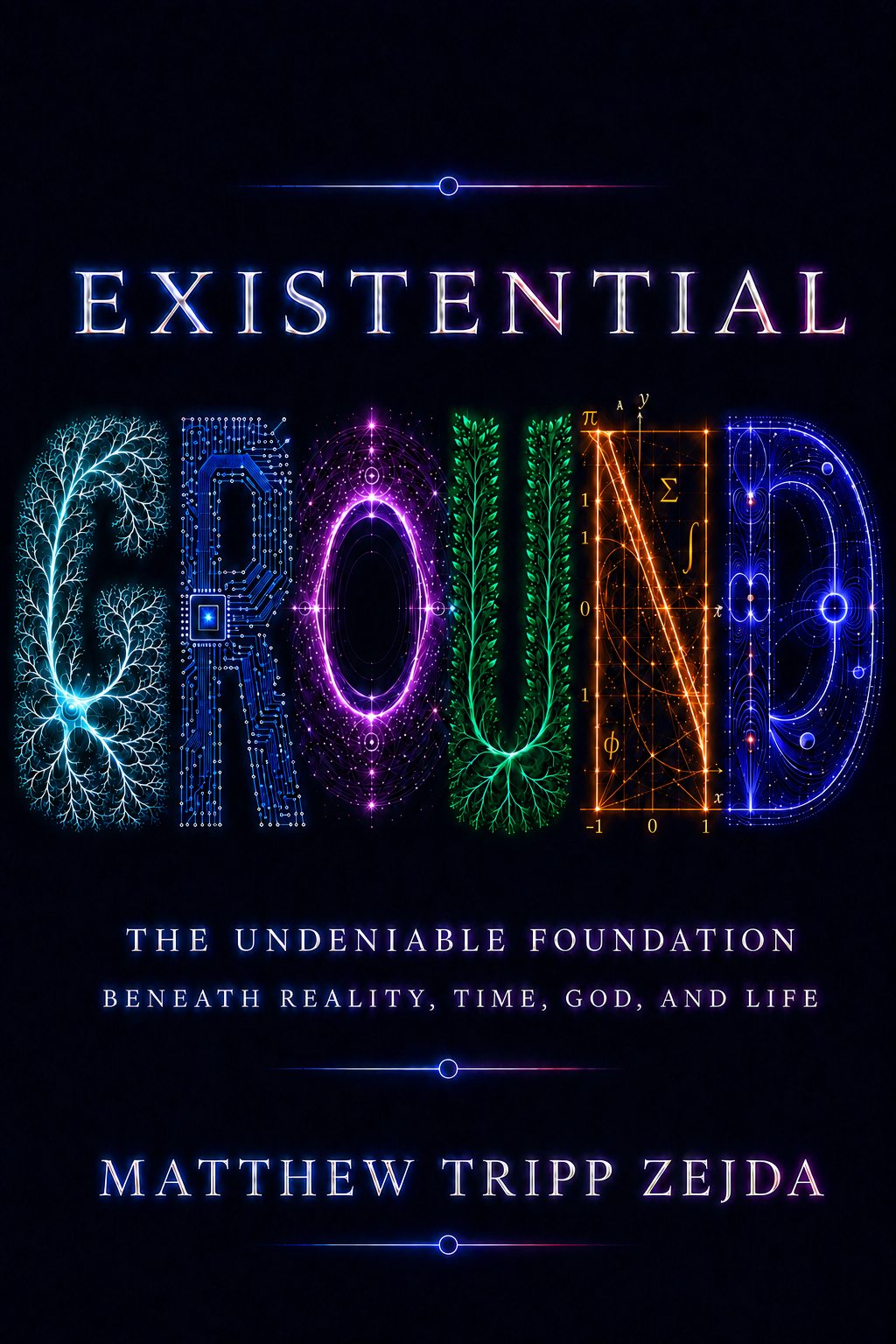
- Existential Ground: The Undeniable Foundation Beneath Reality, Time, God, and Life. Matthew Tripp Zejda. Chapter 14, “Pattern Reality in Identity, Memory, and Mind”; Chapter 16 on caused agency and responsibility; Chapter 18 on meaning, love, and purpose; and Appendix A’s Pattern Reality treatment, especially Theorem A.75 and Proposition A.76 on occurrence, mechanism, and bounded substrate openness. Explore Existential Ground.
- Finite Mind, Finite God. Matthew Zejda. Chapters 1–2 develop the finite-mind and human-interface constraints. Chapter 3 develops the Fairness Clause’s access and capacity conditions. Read about Finite Mind, Finite God.
- Resolution State Interface: Introduction to Universal Relativity. Matthew Tripp Zejda. The physical carrier and identity account, read alongside EG Chapters 12–14. Physical realization is a supporting inquiry with its own evidential requirements, not a replacement for the spectrum or parity arguments. Read about Universal Relativity.
- Memory and social-context studies discussed in the Engine. Nicola S. Clayton and Anthony Dickinson, “Episodic-like Memory During Cache Recovery by Scrub Jays,” Nature 395 (1998), 272–274. N. J. Emery and Nicola S. Clayton, “Effects of Experience and Social Context on Prospective Caching Strategies by Scrub Jays,” Nature 414 (2001), 443–446; erratum, Nature 416 (2002), 349. See Engine §6.4.1 for their distinct roles in the comparison.
- Self-recognition studies discussed in the Engine. Diana Reiss and Lori Marino, “Mirror Self-Recognition in the Bottlenose Dolphin: A Case of Cognitive Convergence,” PNAS 98 (2001), 5937–5942. Joshua M. Plotnik, Frans B. M. de Waal, and Diana Reiss, “Self-Recognition in an Asian Elephant,” PNAS 103 (2006), 17053–17057. These are particular capacity studies, not a universal measure of experience.
- Machine intelligence and understanding. Alan M. Turing, “Computing Machinery and Intelligence,” Mind 59 (1950), 433–460. John R. Searle, “Minds, Brains, and Programs,” Behavioral and Brain Sciences 3 (1980), 417–457. Their different questions are discussed in Engine §6.2 and EG Chapter 14.
- Subjective character and integrated information. Thomas Nagel, “What Is It Like to Be a Bat?,” The Philosophical Review 83 (1974), 435–450. Giulio Tononi, “Consciousness as Integrated Information: A Provisional Manifesto,” The Biological Bulletin 215 (2008), 216–242. These are comparisons discussed in the Engine, not identical formulations of the Spectrum of Consciousness.