
METAPHYSICS · TERMS AND NOTATION
Metaphysics, Ontology, and Explanation
The vocabulary of existence, dependence, possibility, causation, agency, and identity.
I use these terms to move from the fact that something occurs to questions about what exists, what sustains it, and how it continues. The distinctions matter: what grounds an event need not be its first temporal predecessor, and what makes a choice caused need not make it irrelevant.
This reference separates established philosophical meanings from the particular roles they have in Existential Logicism and Existential Ground. Source locations and argument links keep those uses connected to their reasons. These are definitions and explanatory summaries, not substitutes for the full arguments.
All 23 definitions remain visible. Use Find in page, open a lookup panel, or browse the five groups. Numbers 175–197 identify reference entries, not theorems. Lookup labels include related questions and contrasts as well as synonyms; they do not make those meanings identical.
Browse terms and lookup labels A–Z
A
B
C
D
E
F
G
H
I
K
L
M
N
O
P
Q
R
S
Symbols
T
U
V
W
Z
Browse notation by symbol and role
Each symbol leads to the entry explaining its scope. This is a lookup, not a separate set of universal definitions.
- Occ(x): an occurrence in the Engine
- ∃x Occ(x): at least one occurrence in the stated context
- Dep(x,y): dependence in the declared mode
- CDE: complete dependence explanation in LEIR
- □p: necessity in the chosen modal interpretation
- □World: ION’s admissible-reality scope
- ◇p: possibility in the same interpretation
- ◇p ∧ ◇¬p: contingency
- F_L(S): law-admitted successors in PPD
- Next_L(S): the unique successor, when established
- ∅ and 0: empty set and zero, not absolute nonbeing
- N₀: the content denying every occurrence
- a = b: numerical identity
Reality and explanation
What there is, what an account commits to, and what it is trying to explain.
- 175Metaphysics
Lookup: General features of reality · Being, change, and dependence
Metaphysics examines the general character of reality: what there is, how things persist or change, what depends on what, and what could or must be the case. It includes questions about causation, time, identity, and possibility. It is not simply another name for supernatural belief. [S1]
In my work, these questions begin with occurrence and develop into accounts of knowing, dependence, and continuation. Each step has its own argument. Establishing that something occurs does not, on its own, establish a particular cosmology or identify the ultimate physical carrier.
Source location: EG, Chapters 1–3; Engine, Chapter 1 and the Epistemic Refutation Paradox formal section.The Existential Ground
- 176Ontology
Lookup: What exists · Kinds of being · Ontological commitment
Ontology asks what exists and which kinds of things a theory recognizes. An ontological commitment is a commitment to the existence of something, not merely to the usefulness of a word, diagram, or calculation. [S1] [S2]
I distinguish a representation that actually occurs from the reality it describes. A model can organize successful inquiry without every feature of the model being an independently existing ingredient of the world. Conversely, dependence on parts does not make an organized whole unreal. The question is what is instantiated, how it is maintained, and what role it plays.
Source location: EG, Chapters 4, 10, and 14; Engine, Chapter 3, formal sections “Representation and Host-Framework Dependence” and “The Inescapability of Existence”.Representational Shadow Mechanism · Finite Resolution
- 177Existence
Lookup: Being · Occurrence · Occ(x)
Existence concerns whether something is, rather than merely being described, imagined, or named. Philosophers disagree about how existence should be analyzed and which entities a successful account should admit. [S2]
My minimal starting point is occurrence: something happens or obtains. An actual act of denial is itself an occurrence, even when its content is mistaken. In the Engine’s notation, means that occurs. An actual token supplies a witness to in the context containing that token.
This result establishes neither the truth of every representation nor the existence of every represented object. ION’s further claim about admissible exhaustive realities uses its realization and role principle; it is not obtained simply by transferring our present token into every imagined candidate.
Source location: Engine, Chapter 2, Epistemic Refutation Paradox formal section; Chapter 3, ION formal sections 4–5. EG, Chapters 3 and 5.Epistemic Refutation Paradox
- 178Causality
Lookup: Causation · Cause and effect · Causal relation
Causality concerns how causes contribute to effects. Causal accounts may emphasize production, processes, mechanisms, or how an outcome would respond to a relevant change. Mere correlation is not enough to establish a causal relation. [S3] [S4]
I use causal explanation to ask how participating conditions produce a successor configuration. The person deliberating is among those conditions, not outside them. But “has a cause” and “has exactly one possible successor” are different claims. A deterministic account needs the additional conditions that fix continuation.
Grounding asks a different question: in virtue of what does something obtain? A grounding relation is not automatically a prior event, and an earlier event is not automatically a complete explanation.
Source location: EG, Chapters 7, 9, 11–12, and 16; Engine, Chapter 5, PPD formal sections on transition and source sufficiency.Causal Resolution and the Dynamic Ground
- 179Explanation
Lookup: Why and how · Causal explanation · Noncausal explanation · Explanatory adequacy
An explanation addresses why or how something is the case. Some explanations trace causes; others identify what something consists in or what it obtains in virtue of. A description, prediction, or restatement can be useful without answering the same explanatory question. [S4] [S5]
I keep the target of explanation explicit. An account of what sustains a present system, an account of its earlier development, and an account of why this successor occurs need not do the same work. A theory can succeed at one while leaving another open.
LEIR’s complete-dependence requirement and PPD’s contrastive source-sufficiency condition are specific standards used in their respective arguments. Calling an account “complete” does not discharge those standards or turn an explanatory demand into an observed mechanism.
Source location: EG, Chapters 7, 9, 11, and 19; Engine, Chapter 4, LEIR formal section D; Chapter 5, PPD formal treatment of source sufficiency.Grounding and Temporal Beginnings
Grounding, regress, and modality
Dependence, explanatory stopping conditions, necessity, and contingency.
- 180Brute fact
Lookup: Unexplained fact · Unexplainable fact · Explanatory stopping point
A brute fact is taken to obtain without a further explanation. There is a significant difference between saying that an explanation is not presently known and saying that there is none to be given. Merely calling a fact basic does not decide which claim is intended. [S6]
In LEIR, a self-grounded occurrence does not borrow its grounding from a further occurrence in the declared dependence mode. That formal status is not a license to give an unexplained item a reassuring name. The account still has to say what its structure explains.
Likewise, leaving the ultimate carrier or a physical mechanism open is an acknowledged limit of an account, not automatically a declaration that the fact is brute. I separate a defended stopping condition from a gap concealed by a label.
Source location: Engine, Chapter 4, definitions of self-grounded occurrence and complete dependence explanation, with concluding qualifications. EG, Chapters 7, 9, and 19.Logical Elimination of Infinite Regress
- 181Principle of Sufficient Reason (PSR)
Lookup: PSR · Sufficient reason · Reason why
The Principle of Sufficient Reason names a family of claims that facts, events, or beings have adequate reasons or explanations. Versions differ over their scope, whether the requirement is necessary, and what counts as a sufficient reason. It is a substantive philosophical commitment, not a rule that every philosopher accepts. [S6]
I do not use “PSR” as a shortcut that supplies missing premises. LEIR explicitly requires a complete dependence explanation in a fixed mode. PPD separately requires contrastive source sufficiency: a difference in realized outcomes must have a differentiating source or production structure.
Those commitments do different work. Neither is established merely by insisting that an answer would be satisfying. Their formulation and defense remain part of the argument, and their names do not independently select a physical law or a theological conclusion.
Source location: Engine, Chapter 4, LEIR formal sections D–F; Chapter 5, PPD formal source-sufficiency argument. EG, Chapters 7 and 11.Logical Elimination of Infinite Regress
- 182Grounding
Lookup: In virtue of · Metaphysical dependence · Grounding is not temporal firstness · Dep(x,y)
Grounding is usually used for metaphysical dependence: one fact obtains in virtue of another fact or structure. For example, a proposed account may say that a mental fact obtains in virtue of a physical organization. That is a claim about what the fact depends on, not automatically about an earlier event that caused it. [S5]
In my grounding argument, I keep the dependence mode fixed. In the Engine, reads “ depends on ” in that declared mode. A temporal predecessor, an epistemic justification, and an existential ground cannot be exchanged midway through a derivation.
An occurrence is self-grounded relative to that relation when it has no further dependence in that mode. This does not mean that it depends on itself through a reflexive edge. It also does not, by itself, prove a first moment, one unique ground for everything, or numerical identity between the ground and what it sustains.
Source location: Engine, Chapter 4, LEIR formal section B, “Dependence and Regress”, and sections D–F. EG, Chapter 9, “Ground Without a First Moment”.Grounding and Temporal Beginnings
- 183Infinite regress
Lookup: Regress · Deferred dependence · Vicious regress · Benign regress · CDE
An infinite regress is a chain in which each relevant item leads to, or depends on, a further item without a final member in that direction. Whether a regress is objectionable depends on what it is supposed to explain and why continued extension would fail that task. [S7]
LEIR targets purely deferred dependence offered as a complete grounding account. Its complete dependence explanation, abbreviated CDE, requires actual nonborrowed foundations and a finite dependence path from each target to an appropriate foundation, while holding the dependence mode fixed.
This is not the claim that every mathematical infinite sequence is inconsistent, that every feedback loop is impossible, or that all dependence paths must terminate. An account may contain a loop or an indefinitely extended chain while also supplying the required grounding routes. A count of earlier events and an explanation of present dependence remain different questions. EG develops finite actuality and originless continuance through further arguments, rather than extracting a first temporal event from the word “regress”.
Source location: Engine, Chapter 4, LEIR formal sections B–F, including the complete-explanation definition and concluding remarks. EG, Chapters 6–9, especially “The Regress Shadow” and “Ground Without a First Moment”.Logical Elimination of Infinite Regress
- 184Metaphysical necessity
Lookup: Necessity · Necessary truth · Box · □p · Admissible reality
Metaphysical necessity concerns what could not have been otherwise in the relevant metaphysical sense. It is commonly distinguished from what is required by the actual physical laws and from what is certain given someone’s evidence. The relationship between these forms of necessity is itself debated. [S8]
In modal notation, says that holds throughout the alternatives admitted by the interpretation. The scope matters. ION uses for the exhaustive reality-candidates admitted under its realization and role principle.
The source therefore makes its necessity claim with that principle attached. A writable sentence, an empty mathematical domain, a physically realizable state, and an admissible exhaustive actuality are not interchangeable tests. Certainty that a token occurs here is not, by itself, a theorem about every interpretation of modal logic.
Source location: Engine, Chapter 3, “Realization and role principle”, INE theorem, and its modal-scope statement. EG, Chapter 5 and Appendix A’s ION treatment.Illusion of Nothingness
- 185Contingency
Lookup: Contingent truth · Could have been otherwise · Diamond · ◇p · Possible but not necessary
A proposition is contingent when it is true in some relevant possible circumstances and false in others. For an actually true contingent proposition, things could have been otherwise. This differs from not knowing whether a proposition is true. [S8]
Using the same modal interpretation throughout, expresses that both and its negation are possible. It does not say that both obtain together in the actual state.
A deterministic model can still compare different initial conditions or different laws. What it excludes is divergent continuation while its complete relevant source and law remain identical. Likewise, the Contingency Guillotine’s specific claim about valuer dependence is not just a restatement of the general modal definition of contingency.
Source location: Engine, Chapter 5, PPD formal transition definitions; Chapter 7, Contingency Guillotine. EG, Chapters 11 and 16.Persistent Present Determinism · Contingency Guillotine
Determination, agency, and alternatives
Unique continuation, rival accounts of freedom, and the differences that matter to action.
- 186Determinism
Lookup: Causal determinism · Unique continuation · Persistent Present Determinism · PPD · F_L(S) · Next_L(S)
Determinism says that a complete relevant state, together with the laws, fixes a unique continuation. In a familiar historical formulation, an identical complete past and identical laws do not allow different futures. Determinism does not mean that a finite observer can predict the result. [S9]
Persistent Present Determinism is my particular account of source-determined continuation, not a synonym for every deterministic theory. Its formal treatment distinguishes the set of successors admitted by law from a uniquely determined successor. When the required singleton condition is established, the unique-successor function is written .
The derivation retains its present-only complete-source commitment, finite realization, faithful full law, causal closure, contrastive source sufficiency, and actual continuation. Causal closure alone does not establish the stronger contrastive condition; observing one actual outcome does not establish uniqueness either.
A chosen starting index is a reference point, not a proof of reality’s first moment. Deliberation, learning, and intervention remain parts of the determining conditions. The account therefore does not replace agency with fatalism or require an already existing future.
Source location: Engine, Chapter 5, PPD formal definitions of present state, finite-present condition, transition, contrastive source sufficiency, and the main PPD theorem. EG, Chapters 8, 11, and 16.Persistent Present Determinism
- 187Indeterminism
Lookup: Nondeterminism · Multiple lawful continuations · Stochastic law · Chance
Indeterminism denies that the complete relevant prior conditions and laws fix a unique continuation. More than one future may be compatible with those same conditions. Ignorance of the relevant conditions is a different matter: an uncertain prediction need not imply an indeterministic world. [S9] [S13]
A law that specifies probabilities for several outcomes is not thereby formally inconsistent. The stronger issue in PPD is whether that account supplies the contrastive source sufficiency required to explain why this actual successor occurs rather than another.
My argument for that requirement should not be mistaken for the trivial observation that only one result was observed, nor for an empirical demonstration that every stochastic physical theory is false. For agency, adding chance by itself does not establish ownership or control; an indeterministic theory of action must explain those through more than the existence of alternatives.
Source location: Engine, Chapter 5, PPD formal source-sufficiency discussion and its stochastic countermodel boundary. EG, Chapters 11 and 16.Persistent Present Determinism
- 188Free will
Lookup: Freedom of action · Agency and control · Contra-causal freedom · Ultimate authorship
Free will concerns the kind of agency or control involved in choosing and acting. Different theories emphasize alternatives, authorship, reasons-responsive control, or the capacities relevant to moral responsibility. These are connected questions, but they are not one universally agreed definition. [S10]
My target is contra-causal authorship: the proposal that a person can be the ultimate source of a different action while every complete source condition and relevant law remains unchanged. In the deterministic account, that departure is unavailable. Randomness alone does not repair ultimate authorship.
Deliberation, learning, inhibition, planning, and practical self-direction remain real capacities within causation. Rejecting an ultimate uncaused self does not abolish those capacities or make all behavior equally voluntary. Nor does it remove protection, answerability, repair, or the need to assess the effects of an intervention.
Source location: EG, Chapter 16, “Why contra-causal freedom fails ownership”, “Determined agency is still agency”, and “Responsibility without metaphysical blame”. Engine, Chapter 8, DMF formal treatment.Caused Agency and Responsibility · Deterministic Moral Forces
- 189Compatibilism
Lookup: Freedom compatible with determinism · Reasons-responsive control · Acting without coercion
Compatibilism holds that determinism is compatible with free will, or with the relevant freedom required for moral responsibility. It does not, by itself, assert that determinism is true or that every actual person acts freely. A fuller theory must explain the kind of control it preserves. [S11]
I retain the practical distinction between acting through one’s capacities and reasons and acting under coercion, restraint, manipulation, or incapacity. Those differences matter even when every condition has causes.
This overlap does not erase my rejection of ultimate uncaused authorship or automatically endorse every compatibilist account of desert. A protective or corrective response still needs justification through its purpose, evidence, proportionality, and consequences, not simply the label “responsibility”.
Source location: EG, Chapter 16, discussion of freedom traditions, determined agency, and responsibility. Engine, Chapter 8, DMF and the is–ought treatment.Caused Agency and Responsibility · Deterministic Moral Forces
- 190Incompatibilism
Lookup: Freedom incompatible with determinism · Hard determinism · Hard incompatibilism
Incompatibilism holds that determinism and free will, in the sense at issue, cannot both be true. This thesis alone does not decide which is false. Libertarians affirm the relevant freedom; hard determinists accept determinism and reject that freedom. [S12] [S13]
Hard incompatibilist positions reject the relevant freedom whether action is determined or indeterministic. These neighboring terms identify different commitments; they are not interchangeable aliases for the bare incompatibility thesis.
My account rejects contra-causal ultimate authorship while retaining caused agency and practical responsibility. It is therefore important to specify which notion of freedom is being denied and which capacities remain. “Not ultimately self-created” does not mean “unable to deliberate, learn, or affect what happens”.
Source location: EG, Chapter 16, discussion of traditions and the contrast between ultimate authorship and caused agency. Engine, Chapter 8, DMF.Caused Agency and Responsibility · Deterministic Moral Forces
- 191Libertarianism (free will)
Lookup: Libertarian free will · Agent-causal libertarianism · Event-causal libertarianism · Noncausal libertarianism
Libertarianism about free will combines incompatibilism with the claim that the relevant free agency exists. It therefore rejects determinism in the way that freedom requires. This philosophical use is distinct from political libertarianism. [S13]
Libertarian theories differ. Some appeal to agent causation, others to indeterministic event causation, and others to noncausal accounts. They should not all be described as saying that reasons are irrelevant or that an action is merely a random event.
My challenge concerns ownership: what makes the outcome attributable to this person, and what explains the difference between alternatives? Chance alone supplies no answer. Where a theory proposes a further agent-capacity, that capacity and its relation to action need an account rather than an exemption from explanation.
Source location: EG, Chapter 16, comparison of freedom traditions and “Why contra-causal freedom fails ownership”. Engine, Chapter 8, DMF formal treatment.Caused Agency and Responsibility
- 192Counterfactual
Lookup: What would have happened · If things had been different · Alternative source conditions · Intervention comparison
A counterfactual conditional asks what would be the case under a supposition, commonly one that differs from actuality. For example: if a warning had arrived earlier, would the decision have changed? Its truth depends on which differences and background conditions the comparison allows. [S14]
Such reasoning remains useful in a deterministic account. A different warning, skill, resource, or state of attention is a different causal condition. Comparing those cases does not require an identical complete source to produce incompatible actual successors.
An intervention must also matter to the outcome in question. Different source states can converge on the same result, and merely imagining a successful alternative does not show that the proposed change would work. Counterfactuals guide inquiry and correction when the comparison is supported.
Source location: EG, Chapter 16, “Determinism is not fatalism” and “Regret without self-hatred”. Engine, Chapter 5, PPD remarks on distinct sources and continuation.Caused Agency and Responsibility
Nothingness and absence
Local lack, formal nulls, and the stronger proposal of absolute nonbeing.
- 193Nothingness
Lookup: Nothing · Nonbeing · Local nothingness · Abstract nothingness · Empty set · Zero
Nothingness is the philosophical topic of absence, nonbeing, and the different things meant by “nothing”. An empty set, a zero-valued quantity, an empty region, and the denial of every occurrence are different notions. [S15]
ION distinguishes local absence, formal null designations, and absolute nonbeing. A set with no members is still being considered within a mathematical framework. A zero reading says something about a quantity; it does not announce the disappearance of the instrument, relation, or world.
When a null designation is actually used or represented, its use occurs in a host. That establishes the occurrence of the use, not the physical existence of every abstract object and not the realization of the content being described.
Source location: Engine, Chapter 3, ION formal sections 2–4, including local, abstract, and absolute nothingness. EG, Chapter 5, “Nothing Was Never an Option”.Illusion of Nothingness
- 194Absolute nothingness
Lookup: Absolute nonbeing · Total nonbeing · N0 · No occurrence whatsoever
Absolute nothingness is the proposed absence of everything whatsoever: no object, event, state, property, law, relation, capacity, or obtaining fact. It is not a vacant place, a quiet interval, or a physical vacuum, since each of those retains structure. [S15]
In the Engine, the schematic content is . The expression is a sentence, not a name that creates a null object. Its absolute reading excludes an uncounted background as well as the items in an inventory.
ION argues that this content cannot be realized as an exhaustive actuality under the realization and role principle. A proposed obtaining condition already commits to something obtaining; an operative source or receiver commits to the corresponding capacity or relation. Removing every such commitment leaves no realization to do the assigned work.
The argument does not forbid writing an empty-domain formal model. Nor does it place our act of imagining inside that model. It distinguishes a formal candidate from the further claim that the candidate is a realized, exhaustive alternative to occurrence.
Source location: Engine, Chapter 3, definition of Absolute Nothingness, “Realization and role principle”, and INE theorem. EG, Chapter 5 and Appendix A’s ION treatment.Illusion of Nothingness
- 195Absence
Lookup: Local absence · Not present · Nothing of a specified kind · Empty region
An absence is the lack of something specified in a context: no milk in the refrigerator, no signal on a channel, or no member satisfying a condition. The claim identifies what is missing without automatically treating that absence as a separate object. [S15] [S3]
In ION’s local-absence formulation, the relevant region or background is retained and some kind of occupant is denied. The obtaining context supplies the occurrence witness. This is a claim within that context, not an argument from the mere presence of our description.
An absence can matter to an explanation, such as a missing safeguard in an account of an accident. That explanatory role does not make it absolute nonbeing or settle every philosophical question about negative facts and causation.
Source location: Engine, Chapter 3, Local Nothingness definition and the lemma “Local nothingness presupposes occurrences”. EG, Chapter 5.Illusion of Nothingness
Identity and personal continuity
One and the same entity, maintained organization, and the limits of resemblance.
- 196Identity (numerical identity)
Lookup: Identity · Numerical identity · One and the same · a = b · Qualitative similarity
Numerical identity means being one and the same entity. The statement says that the two designations refer to that one entity. Qualitative similarity concerns shared features and can hold between distinct things; even very close resemblance does not by itself establish numerical identity. [S16]
I keep numerical identity separate from dependence. Saying that a person is grounded in reality, or that a system depends on its carrier, does not say that the person or system is identical with the whole of reality or with every aspect of its carrier.
The same caution applies to copying. Two successors can inherit the same pattern and records while becoming distinct participants. If they are distinct from one another, they cannot both be numerically identical to one original in the same one-to-one sense.
Source location: EG, Chapter 14, “Identity lives in maintained closure”, including the branching and reconstruction cases; Chapter 15, identity-with-totality boundary. FMFG, Chapter 7, preference and personhood.Pattern Reality: Identity, Memory, and Mind
- 197Personal identity
Lookup: Identity over time · Psychological continuity · Bodily continuity · Pattern continuity · Memory and identity · Copying and survival
Personal identity asks what makes a person at one time the same person at another. Bodily continuity, psychological continuity, memory, and other criteria feature in different accounts. Evidence that someone resembles or remembers an earlier person is not automatically a complete criterion of identity. [S17]
In Pattern Reality, I examine maintained organization, boundary, record, and causal continuity. A person need not retain every original component to continue as one organized participant. Memory matters, but losing explicit autobiographical access does not by itself remove every bodily and causal continuity.
Branching introduces a further problem. A reconstruction may preserve information without demonstrating that the original first-person subject survives. I do not treat destructive uploading, teleportation, a conversational model, or reconstruction from records as proven personal survival. A copy’s resemblance also does not establish that it is conscious. These distinctions preserve what the account explains without granting what still needs to be established.
Source location: EG, Chapter 14, “A memory is not the remembered thing”, “Identity lives in maintained closure”, and the continuity/copying cases. Engine, Chapter 6, Spectrum of Consciousness.Pattern Reality: Identity, Memory, and Mind
Sources and reading
I use the standard references below for established philosophical vocabulary. They document the wider discussion; they do not thereby endorse my conclusions. The book locations identify my own formulations and the conditions that govern them.
The chapter and section descriptions are locators within the named books, not claims that a publication link opens a particular PDF page. The source argument governs its local terms and symbols.
Existential Logicism: Engine
Matthew Tripp Zejda, Existential Logicism: A Logic-Based Engine for Navigating Reality. The source locations above refer especially to ERP in Chapter 2, ION in Chapter 3, LEIR in Chapter 4, PPD in Chapter 5, SOC in Chapter 6, the Contingency Guillotine in Chapter 7, and DMF in Chapter 8, including their formal sections. Open the Engine publication page.
Existential Ground
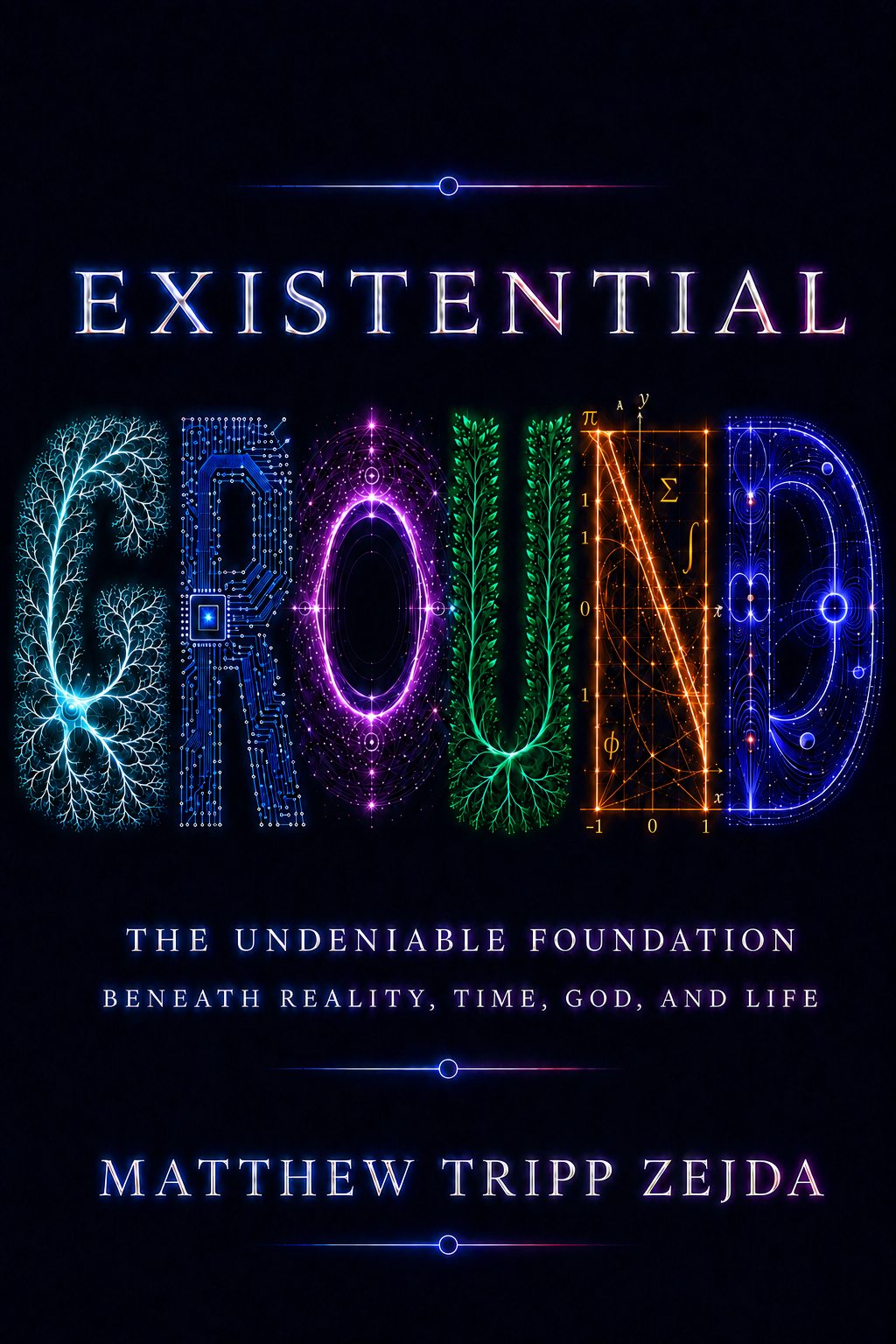
Matthew Tripp Zejda, Existential Ground: The Undeniable Foundation Beneath Reality, Time, God, and Life. Chapters 3–11 develop occurrence, representation, nonbeing, finite actuality, dependence, time, and continuation. Chapters 14–16 develop identity, totality, and agency; Chapter 19 organizes explanatory questions. Appendix A contains the formal proof engine. Open the Existential Ground publication page.
Finite Mind, Finite God
Matthew Zejda, Finite Mind, Finite God. Chapter 7’s preference and personhood argument distinguishes a finite subject from identity with totality. Dependence on a ground is not enough to assert that identity. Open the FMFG publication page.
Standard philosophical references
Stanford Encyclopedia of Philosophy. The entries are linked by title; the notes identify the discussions used here.
- [S1] Metaphysics. Introduction and §§1–3.
- [S2] Existence. Introduction and the distinction between existential assertions and their analysis.
- [S3] Counterfactual Theories of Causation. Introduction and the treatment of causal dependence.
- [S4] Causal Approaches to Scientific Explanation. Introduction; mechanisms and interventionist explanation.
- [S5] Metaphysical Grounding. Introduction and the relationship between grounding and explanation.
- [S6] Principle of Sufficient Reason. Varieties of the principle, brute facts, and explanatory stopping conditions.
- [S7] Infinite Regress Arguments. Introduction and the distinction between a regress and a vicious regress.
- [S8] Varieties of Modality. Introduction and §§1–2, epistemic, metaphysical, and nomic modality.
- [S9] Causal Determinism. Introduction and §2, especially determinism and predictability.
- [S10] Free Will. Introduction and the questions of choice, authorship, and responsibility.
- [S11] Compatibilism. Introduction and the compatibility thesis.
- [S12] Arguments for Incompatibilism. Introduction and the distinctions among incompatibilist positions.
- [S13] Incompatibilist (Nondeterministic) Theories of Free Will. Introduction and noncausal, event-causal, and agent-causal approaches.
- [S14] Counterfactuals. Introduction and the interpretation of counterfactual conditionals.
- [S15] Nothingness. Introduction and the contrast between absence and absolute nonbeing.
- [S16] Identity. §1, numerical and qualitative identity.
- [S17] Personal Identity. Introduction and persistence, psychological continuity, and fission.
Related terminology
A familiar label can help us find a question without settling its answer. Follow the definition into its argument, retain the relevant conditions, and distinguish what has been established from what remains to be explained.