
Hello, World!
Finite Mind, Finite God · The common reference
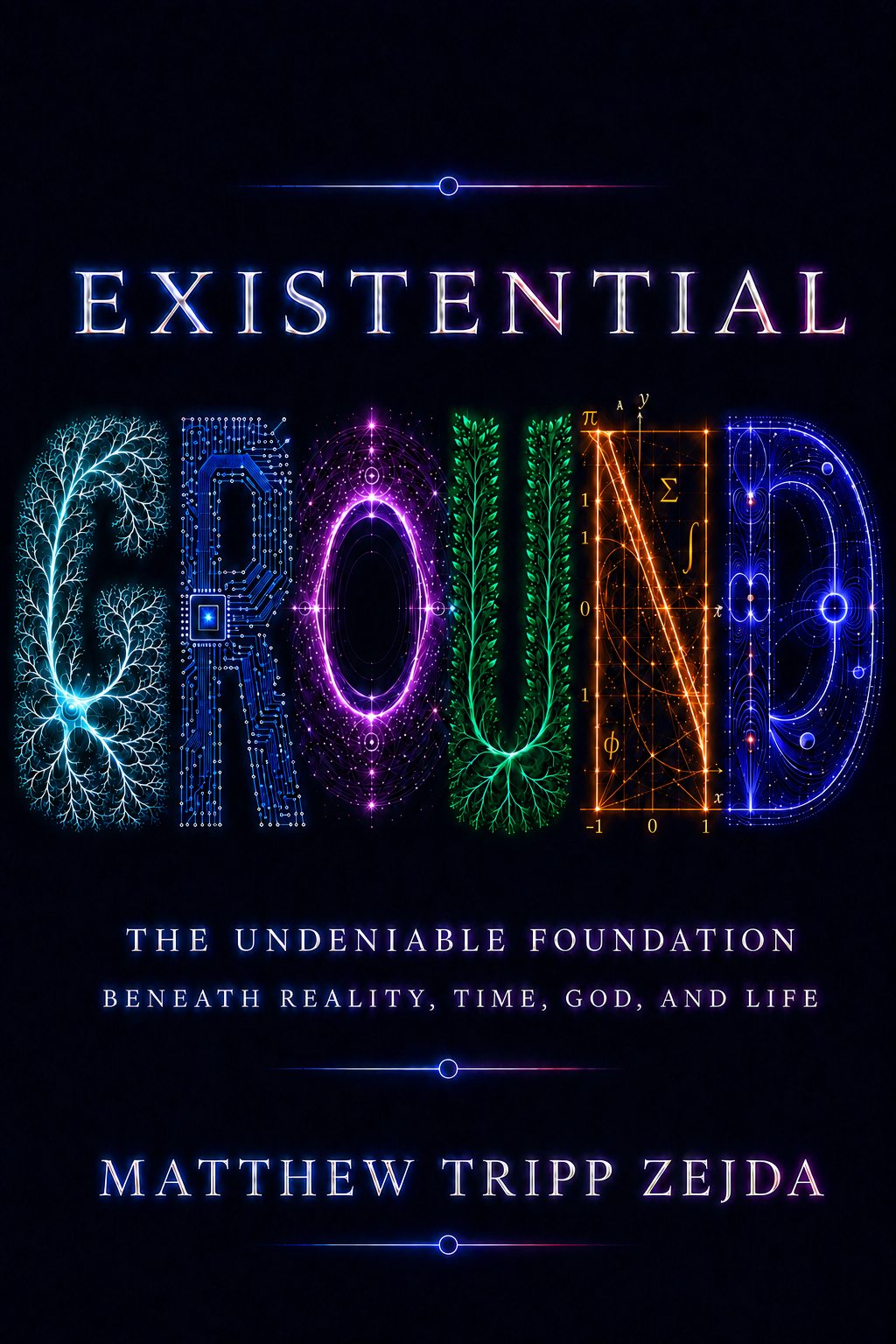
Existential Ground
Before we disagree about God, we already share the reality in which the disagreement occurs. No belief gives one person that reality while leaving another person outside it.
In Finite Mind, Finite God, I use Existential Ground to name the non-optional fact of existence. It is not a consolation left over after a religious claim fails. It is what was already present when the claim was made, when someone believed it, and when someone questioned it. The failure of a description does not remove the reality the description was trying to address. [1] [2]
The important question is therefore not who possesses reality. It is how we understand it, what our descriptions can support, and what follows for the lives we actually share. I begin with occurrence, follow the limits of finite knowing, and then return to meaning, responsibility, and the authority we grant our representations.
The ground is present before the argument begins
The non-optional fact of existence, the shared floor of whatever obtains, which remains after object-level God-claims fail to name a stable kind of thing.
My definition in Finite Mind, Finite God, §11.8.1. [3]
Someone can believe in a personal creator, understand God through nondual language, reject a particular deity, or suspend judgment. Each position still occurs. Its words, doubts, experiences, and reasons belong to whatever obtains. Calling the world an illusion changes the proposed account of those occurrences. It does not make an actual illusion into no occurrence at all.
This is the sense in which the ground is prior to theism and atheism. The priority is not a date before religions existed, and it is not a hidden object below the universe. It concerns what any such position already requires. Before I can ask what is ultimately real, there must be an actual asking. Before a representation can be mistaken, there must be a representation to be mistaken about.
Nor does the ground become available only after the God/no-God frame dissolves. A believer does not stand somewhere else while holding a belief. A nonbeliever does not fall out of existence by declining it. Both are already within the reality their accounts try to describe. Chapter 10 returns to this point because it reverses the familiar suggestion that the believer has a metaphysical possession the nonbeliever lacks. [2]
The ground is shared; our interpretations are not automatically equivalent. Some claims can be better supported than others. Some can be false or incoherent. Beginning from a common reality is the condition for examining those differences, not permission to stop examining them.
What an actual denial cannot remove
The Epistemic Refutation Paradox supplies the minimal starting point. A performed denial of all occurrence is itself an occurrence. Its content says that nothing obtains, while its actual performance supplies something that obtains. The contradiction concerns the global denial and the occurrence in which it is made. It does not depend on first establishing a privileged “I,” a particular material substrate, or a complete theory of consciousness. [4]
Here occurrence is broader than a moving event. In the Engine’s formal definition, an obtaining item, state, fact, event, process, or state-change can count. That prevents a theory from answering the argument merely by proposing that its basic reality is static. Whether that proposal explains the world is a further question; an obtaining state is already something rather than no occurrence.
There is also a difference between a representation occurring and its content being true. A false memory is still an actual memory-token. Its occurrence does not prove the remembered event happened as described. A dream can be real as a dream without making its apparent landscape the world outside the dream. The same distinction applies to a religious experience: recognizing that an experience occurred does not automatically identify its source or establish every interpretation placed on it.
Actual tokening must remain separate from tokenable capacity. An existing system can be capable of forming a representation without having formed that particular representation. The system’s actual existence is not a license to invent a token it never produced. Likewise, a sentence uttered here about an imagined situation elsewhere does not settle that situation merely by occurring here. The denial must be tested against the conditions and scope it actually concerns.
FMFG calls the minimal result token realism. Something obtains when a substantive state is actually tokened. This does not choose materialism over idealism, settle a cosmology, or derive every later EL result. The Illusion of Nothingness addresses absolute nonbeing separately; Logical Elimination of Infinite Regress addresses explanatory dependence; Persistent Present Determinism brings its own temporal and causal premises. Their connection is a dependency structure, not a reason to treat their proofs as interchangeable. [1] [4]
Sharing reality does not require a view from nowhere
The next question is how a finite mind can know anything about what obtains. My answer begins with Tripp’s Prison: whatever I judge, compare, doubt, or accept must be available through my own epistemic interface. An appeal to a God’s-eye view is still a representation I entertain. Merely naming a superior standpoint does not transfer me outside the conditions of representation. [1] [4]
This does not mean that every claim is false or that only my mind exists. It locates the activity of knowing. Different agents can compare independent routes of access, test expectations, encounter resistance, and correct their descriptions. The constructive part of Tripp’s Prison concerns that shared, correctable knowledge. Agreement alone is not its warrant, and a successful shared description need not identify reality’s ultimate carrier.
Finite access also does not make every referent finite in the same way as its representation. A concept and what it purports to describe are different objects of assessment. The finite-mind argument establishes where a concept is available to its thinker. Claims about the referent’s existence, personhood, ultimacy, or relations need their own support.
The Human Interface Thesis applies this constraint to revelation. Whatever the proposed origin, a public revelation claim reaches assessment through experience, memory, language, testimony, transmission, and interpretation. Mediation is not a disproof of revelation. It is the reason a claim of perfect access or binding authority cannot simply exempt itself from examination.
So the common ground is not a demand to stop at private experience. It is the basis for asking how a claim survives comparison beyond one person’s confidence. Finite inquiry can improve without becoming an impossible inspection from outside all inquiry.
What changes when “God” names the whole
The Bad Frame examines a recurring movement between two kinds of claim. One describes a personal agent who wills, commands, chooses, rewards, or punishes. Another invokes unlimited ultimacy or totality. Those are not interchangeable meanings merely because the same name is used for both.
Under the explicit totality reading, “God exists” no longer proposes one additional resident of reality. It refers to the whole within which any resident would obtain. No finite agent is missing that whole. The religious vocabulary may remain meaningful to the person using it, but the name alone does not establish a private metaphysical surplus, a special command, or a privileged interpreter. This is the argument of FMFG’s §10.5.1, not a request that everyone rename reality “God.” [2]
A claim about a distinct agent is different. It can have a particular target, and its existence and capacities can be investigated. Calling that agent extraordinarily powerful does not by itself identify it with everything that obtains. Conversely, rejecting such an agent does not reject the existence of the world in which the proposal was considered.
Grounding scope and identity are different claims
The grounding result below excludes an ontologically independent remainder outside an ultimate’s grounding scope. It must not silently become the additional identity claim that the source is numerically identical with every dependent thing. In the later Existential Ground treatment, I make that distinction explicit: a theology that distinguishes a source from dependent creation still owes an account of their relation, but dependence alone is not numerical identity. [7]
The later personhood argument also states its proper-standpoint premise. A distinct preference-bearing standpoint within reality is not thereby exhaustive reality as such. The Finite God fork tests that standpoint against the further claim of identity with totality. It is not a general rule that wholes never have properties through their parts, and it is not inferred merely because a human being has a finite God-concept.
This leaves the strongest theological responses visible. Analogy, apophatic restraint, and a distinction between ground and creation have to be assessed according to their actual meanings. They are not automatically empty or equivalent to ordinary human psychology. But a shift away from literal personal predicates cannot be reversed without explanation when a detailed personal command is wanted. The claim must keep the same meaning as it moves from ultimacy to authority.
Formal basis and the limits of each step
The formal basis has two connected sources. EL supplies reality as an epistemic ground. FMFG locates concepts within a finite interface and states the grounding-scope constraint. I retain their original statement numbers so each passage can be found in its own book. The complete ERP derivation is available on the ERP page; FMFG’s full opening capstone is developed on The Bad Frame.
Notation in these passages. In the EL selection, R is the proposition that some reality obtains, and G is the global negation of occurrence. In the FMFG selection, G instead denotes a candidate ultimate referent; GM is a God-concept entertained by mind M. These are source-local uses, not one shared variable. ℐ(M) is that mind’s experiential interface. Further notation guidance.
EL: reality as epistemic ground
From the Engine, §2.5, printed pp. 25–26. The references to Theorem 2.4 retain the complete ERP result on which this short deduction depends. [4]
Definition 2.11 (Irrefutability as epistemic ground)
A proposition P is an epistemic ground if every attempt to deny P is self–refuting in the manner of Theorem 2.4. Such propositions cannot be coherently denied from within any epistemic interface; they form the non–negotiable backbone of any rational worldview.
Theorem 2.6 (Reality as epistemic ground)
The proposition
R: “Some reality (some occurrence) obtains.”
is an epistemic ground in the sense of Def. 2.11. Any attempt to deny R from within an epistemic interface is self–refuting.
Proof.
Denying R is equivalent to asserting G (Def. 2.5). By Theorem 2.4, any such assertion from within an epistemic interface falsifies itself. Hence R is an epistemic ground.
□
FMFG: finite concepts and grounding scope
From FMFG, §1.7, printed pp. 11, 13–14. These are the original statements and proofs, selected for the present ground question; they do not receive new theorem numbers. [1]
Theorem 1.1 (Finite Mind Constraint)
Let M be any finite mind, and let C be any concept entertained by M. Then C is necessarily tokened within M's experiential interface. In particular, any God-concept GM entertained by M is an internal representation within experience; it cannot function as a direct external grasp of ultimacy.
Proof sketch.
Entertaining a concept is a cognitive act of M. Any cognitive act that is available to M is, by definition of an epistemic subject, available only through the subject's own presentational medium, here called the experiential interface. Therefore, if C is entertained by M, there exists some internal state of M in which C is presented or encoded for M. That is exactly what it means for C to be tokened within M's interface.
For the second claim, suppose for contradiction that GM functions for M as a direct external grasp of ultimacy, meaning that its content is accessed in a way that is not mediated by any internal tokening within M. Then M would have epistemic access to content that is not presentable within M's own interface. This contradicts the minimal condition for an agent having any epistemic standpoint at all, namely that whatever is available for judgment, assent, denial, or inference is available only via internal presentation. A fully explicit development of this mediation constraint is supplied in Chapter 2 (the Human Interface Thesis and its corollaries).
□
Definition 1.3 (Finite mind and experiential interface)
A mind M is an epistemic subject capable of entertaining concepts, forming doxastic attitudes, and performing inference. The experiential interface of M, written ℐ(M), is the totality of internal presentational states through which anything is available to M for judgment.
M is a finite mind if the information capacity of ℐ(M) is bounded in the minimal sense that M cannot represent, at a single time, arbitrarily many independent distinctions with unbounded precision. No thesis about the material implementation of M is assumed.
A concept C is tokened within ℐ(M) if there exists some state s ∈ ℐ(M) such that s functions as M's internal presentation of C (the state in virtue of which M can entertain, deny, or reason about C).
Lemma 1.5 (Ultimacy collapse schema)
Let G be a candidate referent of an ultimacy-totality God-concept. If G is unlimited and ultimate in the sense that nothing exists outside its grounding scope, then there is no ontologically independent reality outside G. In particular, if there were some existent x outside G, then G would be limited by x and would not be unlimited ultimacy.
Proof.
Assume G is unlimited and ultimate. Suppose, for contradiction, that there exists some x such that x exists and x is outside the grounding scope of G. Then x constitutes an ontological remainder relative to G, which means G does not exhaust the relevant totality. In that case, G is limited by what remains outside it and therefore fails to be unlimited ultimacy. Contradiction. Hence no such x can exist.
□
Remark 1.6
Lemma 1.5 is not a claim about whether reality is personal, impersonal, material, or spiritual. It is a structural claim about the concept of ultimacy: if one asserts an unlimited ultimate, one cannot also consistently posit an ontologically independent remainder outside its scope.
The first result secures occurrence in the relevant epistemic context. The finite-mind result secures mediation. The ultimacy lemma excludes an independent remainder beyond the stated grounding scope. Neither mediation nor that exclusion alone supplies numerical identity with totality, a complete theory of personhood, or an unrestricted moral command. Those further claims must retain their further arguments.
What remains is not a smaller life
Chapter 10 does not finish by saying that a God-concept has failed and leaving a blank space. It returns to the reality, inquiry, value, and reverence that the concept was meant to help us understand. Four commitments organize that positive account. [2]
Existence as the common reference
The first replacement is the simplest: existence itself, as the shared condition of all experience and all inquiry. This is not a god. It is not an agent. It is not a personality. It is the ground that makes all talk possible.
Naming this ground does not solve every question. It relocates questions into honest form. Instead of asking for a cosmic ruler to stop regress, the work becomes understanding how explanation, necessity, and contingency actually function within the world that is given.
FMFG, §10.6.1, “Existential ground as the ultimate common reference,” printed p. 161.
A rejected image does not take the world away with it. The person who cannot sincerely assent to that image still encounters reality, forms relationships, suffers, learns, and acts. No doctrinal declaration changes the fact that their life belongs within the same account.
Interpretive honesty about maps
A tradition can carry language, practices, stories, and disciplines through which people attend to their lives. In the translation-layer account, recognizing that mediation is not the same as declaring every practice worthless or every religious statement false. A representation can be useful while remaining open to correction.
The mistake is granting a finite representation the unquestionable authority of the territory it represents. A story does not become complete because it is sacred, and a practice’s power to orient a person does not settle all of its accompanying metaphysical claims. Translation and control must also remain distinct. The Control Overlays argument concerns the additional mechanisms by which a representation becomes a gate to belonging and inquiry.
Moral reality as lived consequence
The removal of a cosmic judge does not remove people who can be harmed or helped. An injury, an act of care, a broken promise, or a sustained relationship remains part of reality. What changes is the account of the authority and evaluative structure through which those conditions matter.
The Contingency Guillotine examines moral force constituted through valuers. Under that account, an action-guiding moral interpretation cannot depend on valuing while also being independent of every valuer. This is not the claim that an offender’s disapproval makes an injury unreal. It is not a deduction from disagreement, and it is not a claim that every truth becomes subjective because a mind understands it. A deity’s valuation would still be valuation, not independence from all valuers. [5]
Deterministic Moral Forces supplies the connected causal account. Deliberation, habits, education, criticism, care, and institutions affect what people do. Caused agency is not powerless agency. Its causal and evaluative premises are additional to the bare fact of occurrence; the existence of a world does not, by itself, issue a command about how to live.
In the practical account I defend, reducing suffering is the leading standard. That commitment directs attention to actual capacities, needs, relationships, available alternatives, and consequences. It does not make every choice easy or place the chooser outside the situation. Nor does it need a moral fact that would retain its action-guiding force after every valuing relation had been removed.
FMFG’s Fairness Clause and Salvation Paradox examine another part of this consequence. Within the doctrinal commitments being tested, accountability is constrained by access, capacity, and control. Belief is not a direct voluntary switch. The reasoning has to examine sincere inability to assent rather than treating nonbelief itself as proof of moral deficiency. Those arguments have their own premises; a common existential ground does not replace them with a slogan.
Reverence without a personality claim
I can take the world seriously without pretending to know more about it than I do. Gratitude, wonder, love, fear, and the demand for meaning are real features of finite life. They do not have to disappear when a proposed ultimate person is no longer doing the explanatory work.
The distinction in §10.6.4 is exact: reverence is not information about the ultimate. Awe does not establish that the whole is a person. A powerful experience can matter without certifying a complete ontology. Leaving the unknown unknown is not indifference. It keeps the response honest while leaving inquiry open.
This is why I describe the change as a removal of blinders rather than a deprivation. We do not lose reality by giving up a finite picture that claimed to exhaust it. We become responsible for distinguishing what the picture helped us see from what it asked us to accept without support.
Using the distinction in an actual disagreement
Begin by identifying what is being claimed, not by assigning the speaker to a camp. Is the claim about an occurrence, a personal agent, the grounding of dependent things, totality, a practice, or an obligation? Then ask what carries it from one of those roles to another. FMFG’s opening conditions require a coherent target, meaningful intersubjective assessment, more than an unexplained stopping name, and compatibility with the separately established EL constraints. [1]
Consider an illustrative exchange: someone says that God means all reality, and then concludes that this proves a particular command binds everyone. The first claim concerns what the term names. The second attributes a determinate normative demand. The missing step is the warrant connecting totality to that command and to the speaker’s interpretation of it. It is not supplied merely because reality obtains.
The same discipline applies to a purely negative reply. Showing that the proposed command lacks warrant does not erase the speaker’s experience or settle every possible claim about ultimacy. It identifies the unsupported step. We can then ask what account of the experience, the practice, or the moral concern remains defensible.
Chapter 10’s “no blinders” passage gives a practical warning about the point where a representation becomes controlling: it assigns ultimate authority to a finite proxy, treats dissent as moral defect rather than epistemic difference, and closes inquiry by declaring the decisive question answered in advance. These are mechanisms to examine, not a verdict attached automatically to every religion or institution. [2]
The alternative is not a life without commitments. It is a life in which commitments remain answerable to reasons, consequences, and the limits of their support. Neither confidence nor fear gets to perform the missing inference.
How this connects to the later Existential Ground account
The FMFG meaning developed here names the non-optional common floor of whatever obtains. My later book Existential Ground develops a broader integrated account: what cannot coherently be denied, the pseudo-alternatives those facts eliminate, and the positive constraints that validly follow. That development belongs to its own connected argument, presented on The Existential Ground. [6]
The difference matters. A minimal occurrence argument does not silently prove every claim about time, grounding, finitude, agency, or physical implementation. The later account follows those questions through their own premises. It also distinguishes self-grounding from temporal self-causation: total reality does not borrow its actuality from a real source outside everything actual. That is not a story in which reality acts before it exists.
RSI, in turn, is a proposed physical implementation with an independent mathematical and empirical burden. It is not included in the ground simply because it was designed to respect the ground. Naming the shared condition of inquiry is not a substitute for testing a physical model.
The continuity between the books is the demand that our explanations remain within the reality and constraints they are trying to explain. Their different explanatory jobs remain visible. The common floor is not a second world, and the expanded account is not a reason to erase the particular work the FMFG argument does.
Questions about the ground
Is this just redefining God as existence?
No. I do not begin by making “God” the compulsory name for reality. I ask what a particular God-claim means. When its referent is explicitly identified with totality, it is no longer an additional object in the inventory. A personal-agent claim has a different target. The common ground does not depend on adopting either vocabulary. [1] [2]
So is this simply atheism?
A rejection of a particular deity can be correct without finishing the ground question. My purpose is to examine the frame within which the affirmation and denial are being made. That does not make all uses of “theism” or “atheism” identical. It relocates the substantive work to the actual target, its support, and what remains after an unstable description is removed.
Isn’t “existence obtains” too trivial to explain anything?
It is deliberately minimal, but it rules out a global denial that cannot survive its own performance. Its foundational role must not be confused with a completed account of everything within reality. FMFG uses it to locate God-talk and remove the false suggestion that one side possesses reality while another lacks it. Later claims still have to earn their conclusions.
Does removing God remove meaning and morality?
Removing a proposed ultimate judge does not remove suffering, care, relationships, or consequences. CG and DMF explain the evaluative and causal structures at issue rather than treating them as edicts from outside reality. My practical commitment to reducing suffering remains explicit. It is not manufactured from the occurrence theorem alone. [5]
What about religion as relationship rather than metaphysics?
The experience of relationship is something to understand, not something this argument deletes. But identifying its other party, attributing particular intentions, or deriving universal authority are additional claims. Calling religion relational does not make those claims disappear. A practice can retain meaning while its interpretation remains answerable to evidence and coherent use of its terms. [2]
Must an ultimate source be numerically identical with its creation?
That identity does not follow merely from the dependence claim. FMFG’s grounding-scope lemma excludes an ontologically independent remainder. The later EG treatment explicitly separates that result from identifying a source with exhaustive totality. An account that distinguishes source and dependent creation must explain the relation; it must not be replaced by a different premise without notice. [7]
Does finite access trap us in solipsism or arbitrary opinion?
No. An account of how claims enter an interface is not a proof that nothing exists beyond that interface. Tripp’s Prison includes the constructive question of warranted shared structure through comparison, prediction, resistance, and correction. It does not require either a view from nowhere or the claim that agreement creates reality. [4]
Does this establish the complete EG account or a physical theory?
No. It establishes and explains the FMFG ground role through its inherited occurrence argument and finite-interface constraints. The later integrated account needs its further arguments. A proposed physical realization needs its own mathematics, measurements, and failure tests. Preserving those distinctions keeps an established result from being weakened by claims it was never sufficient to prove. [6]
Terms and notation used here
The FMFG terms below use the book’s Chapter 1 and terminology appendix. Occurrence, reality, ERP, and epistemic ground retain their EL source meanings. The later integrated EG definition is identified separately above. [3] [4]
- Existential Ground
- In FMFG, the non-optional fact of existence and the common floor of whatever obtains. It remains when a God-claim fails to name a stable target; it is not produced by that failure.
- God/no-God frame
- The staging of the religious question as a binary affirmation or denial treated as though it already concerns one stable object-level target.
- Collapse proof
- A proof pattern showing that a contested category does not survive the constraints governing it under a specified reading. The claim’s predicates and scope must stay fixed through the test.
- Finite mind
- A mind whose interface cannot represent, at one time, arbitrarily many independent distinctions with unbounded precision. This definition does not select a material implementation.
- Experiential interface
- The internal presentational states through which content is available to a mind for judgment. The interface locates access; it does not make every accessed claim true.
- Finite Mind Constraint
- An entertained concept is tokened within the finite mind’s interface. A claim cannot escape that mediation merely by calling its proposed referent ultimate.
- God-concept tokening
- The actual presentation or encoding of a God-concept within a mind’s interface. Having that concept and establishing its referent are separate matters.
- Human Interface Thesis
- The constraint that public revelation and authority claims are received and assessed through finite cognitive and social channels. It does not infer falsity from mediation alone.
- Epistemic Refutation Paradox
- The result that a global denial of occurrence cannot be true in the context of its actual performance, because that performance is itself an occurrence.
- Occurrence · Occ(x)
- An obtaining item, state, fact, event, process, or state-change. Conscious experience and accurate interpretation are not required by the minimal definition.
- Reality · R
- In EL’s definition, reality is the totality of occurrences; saying that reality obtains says at least one occurrence obtains. In the selected theorem, R specifically labels that proposition rather than an additional object.
- Epistemic ground
- A proposition whose denial is self-refuting in the stated ERP sense. Its status concerns the demonstrated conditions of denial, not the confidence or authority of the speaker.
- Ultimacy
- A claim to final or decisive status in the relevant account. Grounding scope, identity with totality, and literal personal agency must not be conflated.
- Totality
- All that obtains, taken exhaustively. Describing a bearer as included in totality does not thereby identify that bearer with the whole.
Keeping the symbols in their own arguments
M names a mind; C a concept; ℐ(M) its interface; s a state within it. In the token-realism discussion, TokA(S) means an actual tokening by agent A, while CanTokA(S) marks capacity. The implication from actual tokening to capacity does not license the converse. Occ(x) says x is an occurrence. The EL formal selection uses G for the global negation; the FMFG selection uses G for an ultimate referent. A repeated letter is not evidence of a shared meaning.
FMFG Terms and Notation and EL Terms and Notation provide the fuller source-specific reference.
Sources and connected arguments
- Finite Mind, Finite God, Chapter 1, especially §§1.1–1.4 and §1.7, printed pp. 2–6 and 11–14. The common ground, finite mediation, God-concept roles, and the original formal statements used here.
- Finite Mind, Finite God, Chapter 10, §§10.1–10.8, printed pp. 154–166. The shared floor, interpretation, the reversal of metaphysical possession, moral consequences, reverence, and the three “blinders” conditions. The two-paragraph excerpt is §10.6.1, printed p. 161.
- Finite Mind, Finite God, §11.8.1, printed pp. 172–173, with §11.8.2 for interface and revelation vocabulary. The opening definition is the book’s Existential Ground glossary entry.
- Existential Logicism: A Logic-Based Engine for Navigating Reality, §2.5, printed pp. 19–27; §2.11, printed pp. 43–52; and §1.4 for same-context denial scope. The formal selection reproduces Definition 2.11, Theorem 2.6, and its proof, printed pp. 25–26.
- Existential Logicism: A Logic-Based Engine for Navigating Reality, §7.10, printed pp. 214–220; §8.4, printed pp. 234–246; and §8.12, printed pp. 280–282. CG’s constitutive target and DMF’s distinct causal and internal-ought arguments. FMFG Chapters 3–4 supply the fairness and belief-gate applications.
- Existential Ground, Chapter 2, especially §§2.1–2.3, printed pp. 21–23. The later integrated definition, self-grounding versus temporal self-causation, and the independent burden on physical implementations.
- Existential Ground, Chapter 15, especially §§15.3–15.4, printed pp. 254–256. The separately identified grounding/identity distinction and the proper-standpoint premise of the Finite God fork.
Follow the argument
Reference connections
The shared ground is not an award for reaching the correct opinion. It is where our opinions, mistakes, discoveries, and responsibilities already occur. The work is to understand that reality without letting a finite description claim more authority than it can support.